
Key facts
- Brand
- Analog Devices
- Model
- ADSP-BF532
- Industry
- Industrial
- Documents
- 7
- Languages
- EN
- Last added
- 2012-08-03
Start here
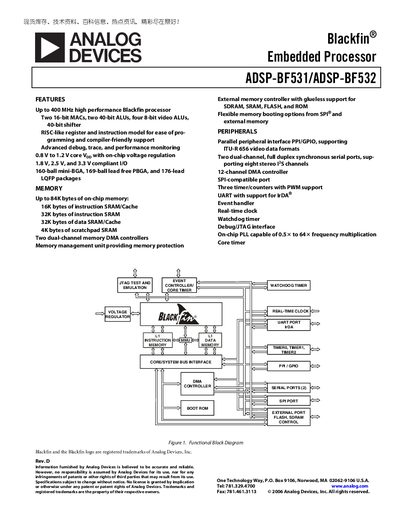
Analog Devices ADSP-BF531/ADSP-BF532 Blackfin Embedded Processor Handbook
The handbook describes the ADSP-BF531 and ADSP-BF532 processors, members of the Blackfin family, highlighting their dual‑MAC, multi‑ALU architecture, low‑power design and portable low‑power features. It explains system integration benefits, including a rich set of peripherals such as UART, SPI, two dual‑channel serial ports, timers with PWM, a real‑time clock, watchdog timer and parallel peripheral interface.
Memory architecture is covered in detail, showing up to 84 KB of on‑chip memory (instruction SRAM, data SRAM and scratchpad), external memory options (SDRAM, SRAM, FLASH) and the memory management unit. The document also outlines booting modes, event handling, exception handling and provides extensive timing and electrical specifications.
Analog Devices ADSP-BF532 specifications
| Push Multiple/Pop Multiple cycles | # core cycles (where # is the number of registers) |
|---|---|
| 32-bit Multiply cycles | 3 cycles |
| Call and Jump cycles | 5 cycles (aligned target) |
| Return from Interrupt cycles | 5 cycles |
| Core Synchronization (CSYNC) cycles | 10 cycles |
Source: Analog Devices ADSP-BF531/532/533 Blackfin Processor Multi-cycle Instructions Latencies Manual
All Analog Devices ADSP-BF532 documents by type
Ratings, dimensions and ordering codes, for selection and design work.
Day-to-day operation, settings and troubleshooting. Start here if the product is already set up.
- Analog Devices ADSP-BF531/ADSP-BF532/ADSP-BF533 Embedded Processor Handbook 56 p
- Analog Devices ADSP-BF531/ADSP-BF532/ADSP-BF533 Blackfin Embedded Processor Handbook 56 p
- Analog Devices ADSP-BF531/ADSP-BF532 Blackfin Embedded Processor Handbook 60 p
- Analog Devices ADSP-BF531/ADSP-BF532 Blackfin Embedded Processor Handbook 60 p
How to use the product for one specific task, with worked examples.
Questions answered in these manuals
What is the cycle count for a 32-bit multiply instruction?
The 32-bit by 32-bit integer multiply instruction always takes 3 cycles to complete.
From: Analog Devices ADSP-BF531/532/533 Blackfin Processor Multi-cycle Instructions Latencies Manual
How many cycles does a Call or Jump instruction take?
All call and jump instructions take 5 cycles to complete, provided the target address is an aligned location.
From: Analog Devices ADSP-BF531/532/533 Blackfin Processor Multi-cycle Instructions Latencies Manual
What is the maximum operating frequency of the ADSP‑BF533?
The ADSP‑BF533 can run up to 600 MHz.
From: Analog Devices ADSP-BF531/ADSP-BF532/ADSP-BF533 Handbook
How many GPIO pins does the processor provide?
The device provides 16 general‑purpose I/O pins.
From: Analog Devices ADSP-BF531/ADSP-BF532/ADSP-BF533 Handbook
What is the maximum operating frequency of the ADSP-BF531/ADSP-BF532/ADSP-BF533 processors?
The BF531 and BF532 run up to 400 MHz, while the BF533 runs up to 600 MHz.
From: Analog Devices ADSP-BF531/ADSP-BF532/ADSP-BF533 Embedded Processor Handbook
How much on‑chip memory is available on these Blackfin processors?
Each device provides up to 148 KB of on‑chip memory, including instruction SRAM, data SRAM, and a 4 KB scratchpad.
From: Analog Devices ADSP-BF531/ADSP-BF532/ADSP-BF533 Embedded Processor Handbook