
Key facts
- Brand
- Agilent
- Model
- 6890 Gas Chromatograph
- Documents
- 8
- Languages
- EN · FR · ES
- Last added
- 2012-07-04
Start here
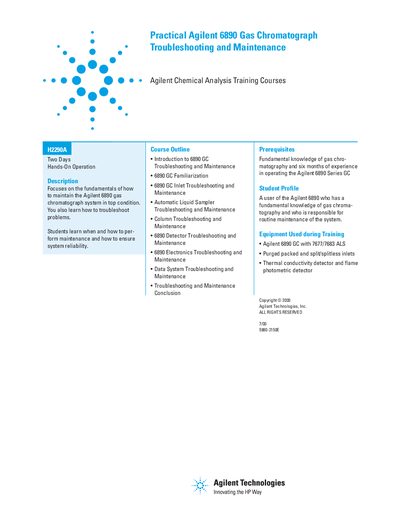
Agilent 6890 Gas Chromatograph Troubleshooting and Maintenance Course Outline
This document outlines a two-day hands-on training course focused on maintaining the Agilent 6890 gas chromatograph system in top condition. The curriculum covers fundamental troubleshooting techniques to ensure system reliability.
The course is designed for users with six months of experience operating the Agilent 6890 Series GC and fundamental knowledge of gas chromatography. Training includes practical sessions on inlet, automatic liquid sampler, column, detector, electronics, and data system maintenance.
Agilent 6890 Gas Chromatograph specifications
| Purge rate | 50 mL/min |
|---|---|
| Desorb temperature | 260 °C |
| Bake temperature | 270 °C |
| Inlet temperature | 200 °C |
| Split ratio | 35:1 |
| Column length | 20m |
| Column diameter | 180 ym |
| Source temperature | 200 °C |
| Transfer line temperature | 250 °C |
Source: Agilent 6890/5973 GC-MS System Application Note for EPA Method 524.2
All Agilent 6890 Gas Chromatograph documents by type
Disassembly, diagnostics and part numbers, for repair.
How to use the product for one specific task, with worked examples.
Mounting, wiring and first power-up. Read it before the hardware goes in.
Questions answered in these manuals
What are the prerequisites for this training?
Students need fundamental knowledge of gas chromatography and six months of experience in operating the Agilent 6890 Series GC.
From: Agilent 6890 Gas Chromatograph Troubleshooting and Maintenance Course Outline
What equipment is used during the training?
The training uses an Agilent 6890 GC with 7677/7683 ALS, purged packed and split/splitless inlets, thermal conductivity detector, and flame photometric detector.
From: Agilent 6890 Gas Chromatograph Troubleshooting and Maintenance Course Outline
How many volatile organic compounds can be analyzed using this method?
The system was used to determine 61 volatile organic compounds (VOCs).
From: Agilent 6890/5973 GC-MS System Application Note for EPA Method 524.2
Does this method require cryofocusing?
No, all U.S. EPA method 524.2 criteria were met without using cryofocusing.
From: Agilent 6890/5973 GC-MS System Application Note for EPA Method 524.2
What safety warning indicates a risk of bodily injury?
The AVERT. warning indicates a risk of bodily injury.
What is the correct procedure for tightening the adjustment screw on a newly installed valve?
Turn the rotor adjustment screw counter-clockwise with a flathead screwdriver until it stops, then turn it slightly in the other direction to define the rotor movement limit.