
This application note introduces a new method for studying the dynamics of biomolecules, based on ultrafast NMR spectroscopy and the performance of Varian cold probes.
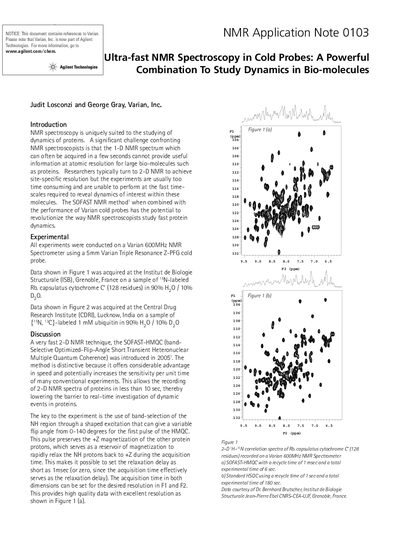
This document describes the powerful combination of SOFAST NMR spectroscopy and Varian cold probe technology for studying the dynamics of bio-molecules, specifically proteins. It addresses the challenge of acquiring high-resolution data on large proteins quickly, which is difficult with standard 1-D or time-consuming 2-D NMR methods.
| Probe Type | 5mm Varian Triple Resonance Z-PFG cold probe |
|---|---|
| Recycle Time | 1 msec |
| Total Experimental Time (SOFAST) | 6 sec |
| Total Experimental Time (Standard HSQC) | 180 sec |
It allows the recording of 2-D NMR spectra of proteins in less than 10 sec, lowering the barrier to real-time investigation of dynamic events.
The total experimental time is 6 seconds.
The duty cycle increases from the typical 8% to over 80%.