
Key facts
- Brand
- Texas Instruments
- Model
- TL16C550CI
- Industry
- Industrial
- Documents
- 2
- Languages
- EN
- Last added
- 2012-08-09
Start here
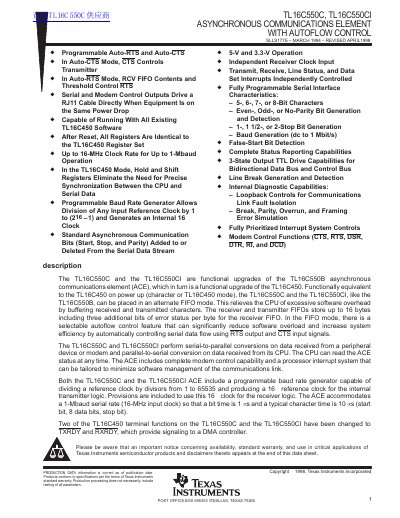
Texas Instruments TL16C550C TL16C550CI Asynchronous Communications Element Datasheet
The TL16C550C and TL16C550CI are functional upgrades of the TL16C550B asynchronous communications element (ACE). These devices perform serial-to-parallel and parallel-to-serial conversions and include complete modem control capability. They are functionally equivalent to the TL16C450 on power up but offer enhanced features such as selectable autoflow control to reduce software overhead.
Read onlineTexas Instruments TL16C550CI specifications
| Clock Rate | Upto 16-MHz |
|---|---|
| Baud Rate | dc to 1 Mbit/s |
| Character Size | 5-,6-, 7-, or 8-Bit |
| Stop Bits | 1-, 1 1/2-, or 2-Stop Bit |
| FIFO Capacity | up to 16 bytes |
| Operation Voltage | 5-V and 3.3-V |
Source: Texas Instruments TL16C550C TL16C550CI Asynchronous Communications Element Datasheet
All Texas Instruments TL16C550CI documents by type
Ratings, dimensions and ordering codes, for selection and design work.
Questions answered in these manuals
What is autoflow control?
Autoflow control is comprised of auto-CTS and auto-RTS, which automatically control serial data flow using RTS output and CTS input signals.
From: Texas Instruments TL16C550C TL16C550CI Asynchronous Communications Element Datasheet
Can the TL16C550C run with existing TL16C450 software?
Yes, the device is capable of running with all existing TL16C450 software.
From: Texas Instruments TL16C550C TL16C550CI Asynchronous Communications Element Datasheet
What does autoflow control do?
Autoflow control combines auto‑CTS and auto‑RTS to automatically manage serial data flow, reducing interrupt load and preventing overrun errors.
How is the baud rate generated?
A programmable baud‑rate generator divides any input reference clock by 1 to 65 535 and provides a 16× clock for the transmitter and receiver.