
Key facts
- Brand
- Texas Instruments
- Model
- SN65HVD10
- Category
- Other Electronics
- Documents
- 2
- Languages
- EN
- Last added
- 2012-06-01
Start here
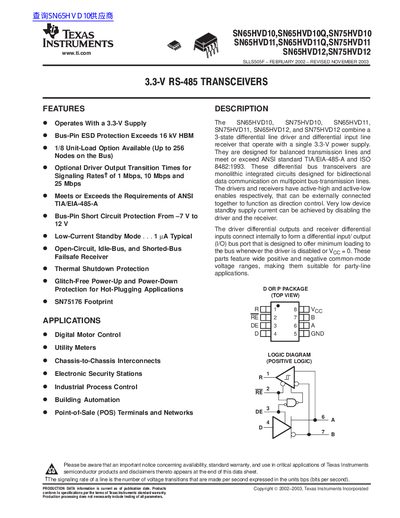
Texas Instruments SN65HVD10 RS‑485 Transceiver Datasheet
The SN65HVD10 family combines a 3‑state differential line driver and receiver that operate from a single 3.3‑V supply. They meet ANSI TIA/EIA‑485‑A and ISO 8482:1993 standards and are suited for balanced multipoint bus applications such as industrial process control, building automation, and POS networks.
Key features include optional 1/8 unit‑load operation for up to 256 nodes, selectable signaling rates of 1 Mbps, 10 Mbps or 25 Mbps, and robust protection like 16 kV HBM ESD and thermal shutdown. The devices are offered in various PDIP and SOIC packages with detailed electrical and thermal specifications.
Texas Instruments SN65HVD10 specifications
| Supply voltage (Voc) | 3 V – 3.6 V |
|---|---|
| Unit‑load option | 1/8 unit‑load (up to 256 nodes) |
| Junction temperature (Ty) | 170 °C (max) |
| Thermal shutdown temperature | 165 °C |
Source: Texas Instruments SN65HVD10 RS‑485 Transceiver Datasheet
All Texas Instruments SN65HVD10 documents by type
Ratings, dimensions and ordering codes, for selection and design work.
Questions answered in these manuals
What supply voltage does the SN65HVD10 require?
The device operates from a 3.3 V supply with a permissible range of 3 V to 3.6 V.
From: Texas Instruments SN65HVD10 RS‑485 Transceiver Datasheet
Does the SN65HVD10 provide ESD protection?
Yes, the bus‑pin ESD protection exceeds 16 kV HBM.
From: Texas Instruments SN65HVD10 RS‑485 Transceiver Datasheet
What is the supply voltage range for the SN65HVD1040?
The device operates with a supply voltage between 4.75 V and 5.25 V.
From: Texas Instruments SN65HVD1040 CAN Transceiver Datasheet
How does the SN65HVD1040 enter low‑power standby mode?
Applying a high logic level to the STB pin puts the transceiver into a low‑power bus‑monitor standby mode.
From: Texas Instruments SN65HVD1040 CAN Transceiver Datasheet