
Key facts
- Brand
- STMicroelectronics
- Model
- STLC3075
- Category
- Other Electronics
- Documents
- 2
- Languages
- EN
- Last added
- 2012-08-09
Start here
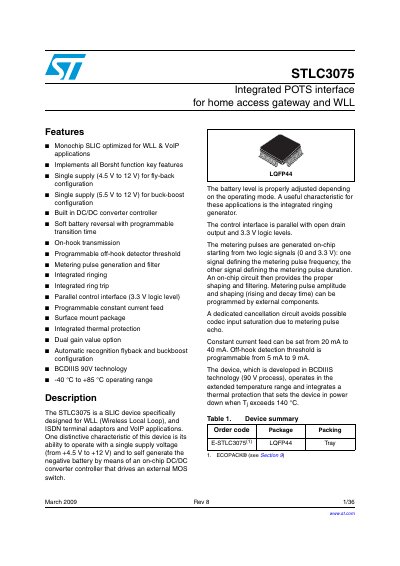
STLC3075 Integrated POTS Interface Datasheet
The STLC3075 is a monolithic SLIC (Subscriber Line Interface Circuit) device optimized for Wireless Local Loop (WLL), ISDN terminal adaptors, and Voice over IP (VoIP) applications. It features an integrated DC/DC converter controller that allows operation with a single supply voltage ranging from 4.5 V to 12 V, enabling both fly-back and buck-boost configurations without external negative battery generation circuits.
The device implements all Borscht function key features, including soft battery reversal with programmable transition time, on-hook transmission, integrated ringing generation, and metering pulse generation. It operates in a temperature range of -40 °C to +85 °C using 90 V BCDIIIS technology and includes built-in thermal protection.
STMicroelectronics STLC3075 specifications
| Operating temperature range | -40 °C to +85 °C |
|---|---|
| Supply voltage (fly-back) | 4.5 V to 12 V |
| Supply voltage (buck-boost) | 5.5 V to 12 V |
| Technology process | 90 V BCDIIIS |
| Thermal protection threshold | 140 °C |
All STMicroelectronics STLC3075 documents by type
Ratings, dimensions and ordering codes, for selection and design work.
How to use the product for one specific task, with worked examples.
Questions answered in these manuals
What is the operating voltage range for fly-back configuration?
The device operates with a single supply from +4.5 V to +12 V in fly-back mode.
What is the operating voltage range for buck-boost configuration?
The device operates with a single supply from +5.5 V to +12 V in buck-boost mode.
What is the typical clock frequency for the STLC3075?
The typical clock signal frequency is 125 kHz.
How is the VBAT voltage level defined?
The VBAT voltage level is defined by the voltage divider RF1 / RF2.