
Key facts
- Brand
- Analog Devices
- Model
- AD74111
- Industry
- Industrial
- Documents
- 3
- Languages
- EN
- Last added
- 2012-08-03
Start here
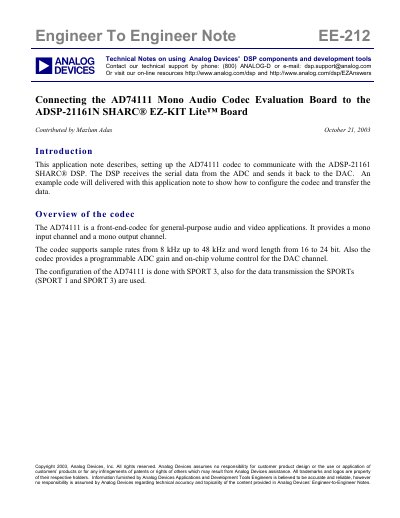
Analog Devices EE-212 Connecting the AD74111 Mono Audio Codec Evaluation Board to the ADSP-21161N SHARC EZ-KIT Lite Boar
This document provides technical guidance on connecting the AD74111 Mono Audio Codec Evaluation Board to the ADSP-21161N SHARC EZ-KIT Lite Board. It details the necessary jumper settings for both boards to ensure proper signal synchronization and ground connections between them.
The guide explains the software flow for data transmission, covering the initialization of the DSP and codec, configuration via SPORT 3, and the setup of DMA channels using chained transfers. It includes specific register values for configuring the AD74111 control registers.
Analog Devices AD74111 specifications
| Sample rates supported | 8 kHz up to 48 kHz |
|---|---|
| Word length range | 16 to 24 bit |
| Channels provided | Mono input and Mono output |
All Analog Devices AD74111 documents by type
Ratings, dimensions and ordering codes, for selection and design work.
How to use the product for one specific task, with worked examples.
Questions answered in these manuals
How is the AD74111 codec reset?
The codec is reset using Flag 0 to generate a reset signal, which must meet specific timing requirements (tRES, tRS and tRH) for 3072 MCLK periods.
What are the two modes of operation for the AD74111 codec?
The codec operates in Mixed mode (default, allows register configuration) and Data mode (only data transmission).
What sample rate range does the AD74111 support?
It supports sample rates from 8 kHz to 48 kHz.
From: Analog Devices AD74111 Mono Audio Codec Product Handbook
What is the ADC resolution of the AD74111?
The ADC has a 24‑bit resolution.
From: Analog Devices AD74111 Mono Audio Codec Product Handbook
What is the maximum sample rate of the AD74111?
The AD74111 can operate at sample rates up to 48 kHz.
How many gain steps does the ADC programmable gain provide?
The ADC gain can be programmed in 3 dB steps from 0 dB to 12 dB.