
Key facts
- Brand
- Fairchild
- Model
- FAN103
- Category
- Other Electronics
- Documents
- 2
- Languages
- EN
- Last added
- 2012-08-01
Start here
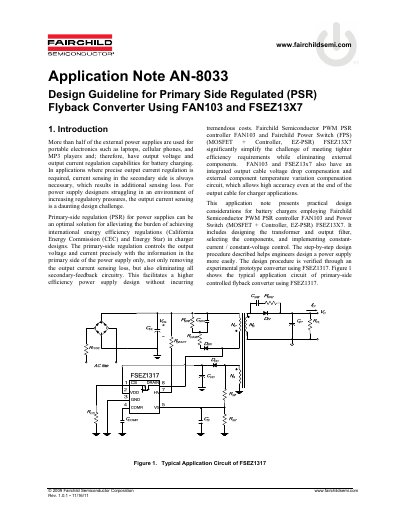
Design Guideline for PSR Flyback Converter Using FAN103 and FSEZ13X7
This document serves as a design guideline for creating primary-side regulated (PSR) flyback converters, specifically utilizing the Fairchild Semiconductor FAN103 PWM PSR controller and the FSEZ13X7 Power Switch (EZ-PSR). It addresses the challenges of meeting international energy efficiency regulations for portable electronics chargers by eliminating secondary-side sensing components.
The note details the operation principles of PSR in discontinuous conduction mode (DCM) and provides a step-by-step design procedure. Key topics include estimating efficiencies for various operating points, designing the transformer to ensure DCM operation across the full load range, and implementing constant-current/constant-voltage control strategies.
All Fairchild FAN103 documents by type
How to use the product for one specific task, with worked examples.
Questions answered in these manuals
What is the main benefit of Primary-Side Regulation (PSR)?
PSR alleviates the burden of achieving energy efficiency regulations by removing output current sensing loss and eliminating all secondary-feedback circuitry.
From: Design Guideline for PSR Flyback Converter Using FAN103 and FSEZ13X7
What is the recommended conduction mode for PSR?
Discontinuous conduction mode (DCM) is preferred for primary-side regulation since it allows better output regulation.
From: Design Guideline for PSR Flyback Converter Using FAN103 and FSEZ13X7
What is the recommended DC link capacitor value per watt for universal input ranges?
It is typical to select a DC link capacitor as 2-3uF per watt of input power.
At what frequency does the converter operate when the output voltage drops below 70% of its nominal value?
The frequency is reduced to 33kHz to prevent CCM operation.