
Key facts
- Brand
- Analog Devices
- Model
- AD1953
- Industry
- Industrial
- Documents
- 3
- Languages
- EN
- Last added
- 2012-08-03
Start here
Analog Devices AN-620 Using the AD1836 AD1953 for a 4-In/9-Out Analog System with DSP
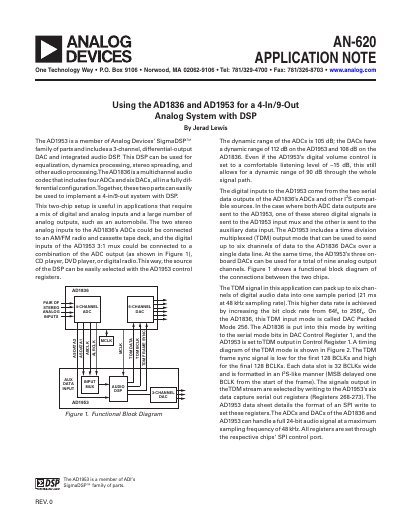
This document details a system configuration using the AD1836 multichannel audio codec and the AD1953 SigmaDSP family part. The setup combines the four analog inputs of the AD1836 with the digital processing capabilities of the AD1953 to create a 4-in/9-out system suitable for applications like automobiles.
Read onlineAnalog Devices AD1953 specifications
| ADC Dynamic Range | 105 dB |
|---|---|
| AD1953 DAC Dynamic Range | 112 dB |
| AD1836 DAC Dynamic Range | 108 dB |
| Maximum Sampling Frequency | 48 kHz |
Source: Analog Devices AN-620 Using the AD1836 AD1953 for a 4-In/9-Out Analog System with DSP
All Analog Devices AD1953 documents by type
Ratings, dimensions and ordering codes, for selection and design work.
How to use the product for one specific task, with worked examples.
Questions answered in these manuals
What is the total number of analog outputs in this system?
The system provides a total of nine analog output channels.
From: Analog Devices AN-620 Using the AD1836 AD1953 for a 4-In/9-Out Analog System with DSP
What is the maximum sampling frequency supported by the ADCs and DACs?
The ADCs and DACs can handle a maximum sampling frequency of 48 kHz.
From: Analog Devices AN-620 Using the AD1836 AD1953 for a 4-In/9-Out Analog System with DSP
How can the AD1953 be programmed?
It can be programmed via the SPI port, which includes a safe‑upload mode for transparent parameter updates.
What is the supply voltage for the AD1953?
The AD1953 operates from a 5.0 V supply for both AVDD and DVDD.
What is the signal‑to‑noise ratio of the AD1953?
The device achieves a 112 dB A‑weighted signal‑to‑noise ratio at a 48 kHz sample rate.