
Key facts
Start here
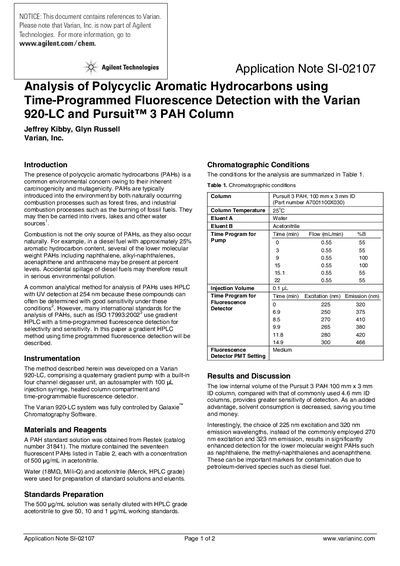
Varian 920-LC PAH Analysis Application Note
This document details an analytical method for detecting polycyclic aromatic hydrocarbons (PAHs) using High-Performance Liquid Chromatography (HPLC) with time-programmed fluorescence detection. The method utilizes the Varian 920-LC system equipped with a quaternary gradient pump, autosampler, and a time-programmable fluorescence detector.
The analysis employs a Pursuit 3 PAH column (100 mm x 3 mm ID) to separate seventeen fluorescent PAHs. The method achieves superior sensitivity and selectivity, with limits of detection for individual PAHs considerably lower than those specified in ISO 17993:2002. The note provides specific chromatographic conditions, including eluent gradients, flow rates, and fluorescence excitation/emission wavelengths, along with typical retention times and detection limits.
Agilent Pursuit 3 PAH specifications
| Column Dimensions | 100 mm x 3 mm ID |
|---|---|
| Column Temperature | 25°C |
| Injection Volume | 0.1 µL |
| Eluent A | Water |
| Eluent B | Acetonitrile |
All Agilent Pursuit 3 PAH documents by type
How to use the product for one specific task, with worked examples.
Questions answered in these manuals
Which PAHs are non-fluorescent in this analysis?
Acenaphthylene is non-fluorescent and elutes between naphthalene and 1-methyl naphthalene.
What is the total analysis time for the chromatogram?
The separation of all fluorescent PAHs is achieved in sixteen minutes.
How long does the HPLC analysis take for 24 PAHs?
The optimized chromatogram led to a separation of 24 PAHs in 27 minutes.
From: Agilent Pursuit 3 PAH Column Application Note for 24 PAHs Analysis
Which sorbent is recommended for the SPE method?
The method achieved best results using the polymer-based sorbent Bond Elut Plexa.
From: Agilent Pursuit 3 PAH Column Application Note for 24 PAHs Analysis