
Describes a method for the analysis of polycyclic aromatic hydrocarbons (PAHs) using the Varian 920-LC and Pursuit™ 3 PAH Column
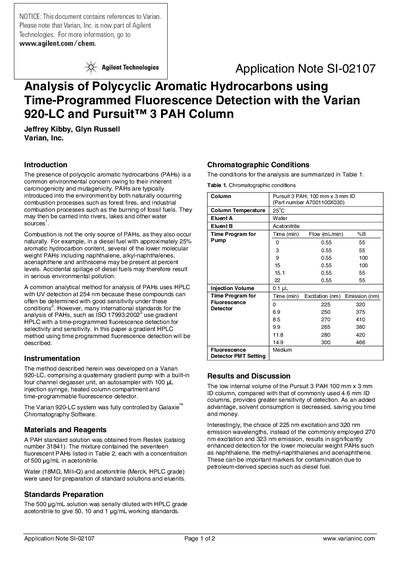
This document details an analytical method for detecting polycyclic aromatic hydrocarbons (PAHs) using High-Performance Liquid Chromatography (HPLC) with time-programmed fluorescence detection. The method utilizes the Varian 920-LC system equipped with a quaternary gradient pump, autosampler, and a time-programmable fluorescence detector.
The analysis employs a Pursuit 3 PAH column (100 mm x 3 mm ID) to separate seventeen fluorescent PAHs. The method achieves superior sensitivity and selectivity, with limits of detection for individual PAHs considerably lower than those specified in ISO 17993:2002. The note provides specific chromatographic conditions, including eluent gradients, flow rates, and fluorescence excitation/emission wavelengths, along with typical retention times and detection limits.
| Column Dimensions | 100 mm x 3 mm ID |
|---|---|
| Column Temperature | 25°C |
| Injection Volume | 0.1 µL |
| Eluent A | Water |
| Eluent B | Acetonitrile |
Acenaphthylene is non-fluorescent and elutes between naphthalene and 1-methyl naphthalene.
The separation of all fluorescent PAHs is achieved in sixteen minutes.