
The Varian 385-LC is an advanced evaporative light scattering detector from Polymer Laboratories, now a part of Varian, Inc. The Varian 385-LC delivers sub-ambient evaporation down to 10 °C, providing maximum sensitivity for compounds with significant volatility below ambient temperature. The instrument benefits from fast data output rates and extremely low dispersion for fast LC, and delivers a universal response down to the low-nanogram range for truly representative analysis. Reproducibility is less than 2% for improved consistency of results. The Varian 385-LC offers real time gas management that eliminates solvent effects to give a constant response across a gradient. Control and digital data collection come as standard for multi-vendor platforms and so there is no need for an analog to digital converter. On-the-fly adjustment of light source intensity saves time during a run, too - all this in the smallest footprint around. Being complementary to LC/MS, and offering unrivalled flexibility and sensitivity, the Varian 385-LC is the ELSD of choice for the most demanding applications. The success of ELS detection relies on evaporating the eluent without destroying the analyte particle. Where the analyte is non-volatile, evaporator temperatures of 50-100 °C can be used without compounds degrading, thus giving maximum sensitivity. However, when compounds have high vapor pressures and the eluent has a high boiling point (eg water), since the evaporation rate of the eluent is much lower than that of the analyte, the light scattering signal will be reduced. The Varian 385-LC uses a unique condenser design to provide high sensitivity in this case.
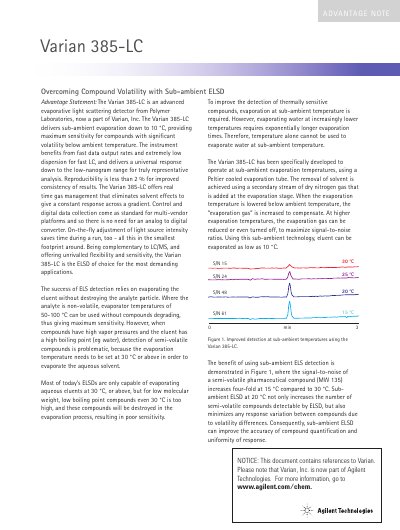
The Varian 385-LC is an advanced evaporative light scattering detector (ELSD) designed to overcome compound volatility. It features sub-ambient evaporation capabilities, utilizing a Peltier cooled evaporation tube and a secondary stream of dry nitrogen gas to evaporate eluents as low as 10°C. This technology allows for the detection of semi-volatile and low molecular weight compounds that would otherwise be destroyed at standard evaporation temperatures of 30°C or higher.
| Minimum evaporation temperature | 10 °C |
|---|---|
| Reproducibility | less than 2 % |
| Response range | low-nanogram range |
The instrument can deliver sub-ambient evaporation down to 10 °C.
It uses a secondary stream of dry nitrogen gas added at the evaporation stage to remove solvent when the temperature is lowered.