
Key facts
Start here
Varian PL-SAX 1000A Chromatographic Packing Material Product Leaflet
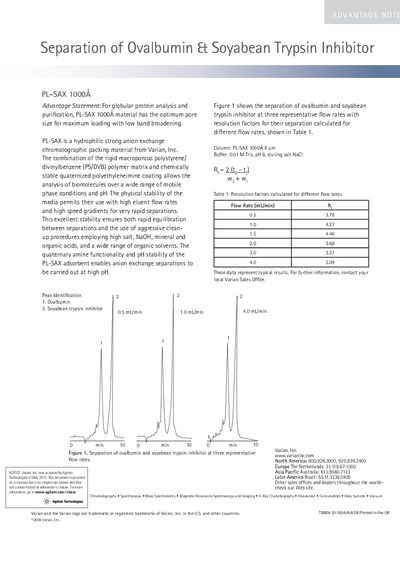
The Varian PL-SAX 1000A is a hydrophilic strong anion exchange chromatographic packing material designed for the analysis and purification of globular proteins. It features a rigid macroporous polystyrene/divinylbenzene (PS/DVB) polymer matrix with a chemically stable quaternized polyethyleneimine coating. This construction allows for analysis under a wide range of mobile phase conditions and pH levels, while maintaining physical stability for high eluent flow rates and high-speed gradients.
The material offers excellent stability, permitting rapid equilibration between separations and the use of aggressive cleanup procedures involving high salt, NaOH, mineral and organic acids, and a wide range of organic solvents. Its quaternary amine functionality enables anion exchange separations to be carried out at high pH. The document includes typical separation data for ovalbumin and soyabean trypsin inhibitor at various flow rates.
Agilent PL-SAX 1000A specifications
| Application | globular protein analysis and purification |
|---|---|
| Matrix Type | rigid macroporous polystyrene/divinylbenzene (PS/DVB) polymer matrix |
| Coating | chemically stable quaternized polyethyleneimine coating |
| Functionality | quaternary amine functionality |
| Flow Rate Capability | high eluent flow rates |
Source: Varian PL-SAX 1000A Chromatographic Packing Material Product Leaflet
All Agilent PL-SAX 1000A documents by type
How to use the product for one specific task, with worked examples.
Questions answered in these manuals
What is the primary use of PL-SAX 1000A?
It is used for globular protein analysis and purification.
From: Varian PL-SAX 1000A Chromatographic Packing Material Product Leaflet
Can PL-SAX 1000A be used with high pH conditions?
Yes, the quaternary amine functionality enables anion exchange separations to be carried out at high pH.
From: Varian PL-SAX 1000A Chromatographic Packing Material Product Leaflet
What eluent is used for separating poly-T oligonucleotides?
Eluent A is 7:93 v/v acetonitrile: 0.1 M TEAA, pH 8.5, and Eluent B is 7:93 v/v acetonitrile: 0.1 M TEAA, 1 M ammonium chloride pH 8.5.
From: Agilent PL-SAX 1000A Strong Anion-Exchange HPLC Columns Application Note
What conditions are used to separate thiolated oligonucleotides?
The separation uses sodium hydroxide as the eluent with a gradient from 75-100% B for 25 min followed by 0-100% B in 20 min.
From: Agilent PL-SAX 1000A Strong Anion-Exchange HPLC Columns Application Note