
Agilent G2350A Atomic Emission Detector (AED) is a gas chromatograph-mass spectrometer that can detect carbon, sulfur, nitrogen, hydrogen, chlorine, phosphorus, and oxygen. The instrument uses molecular spectroscopy and atomic emission spectroscopy, which has high sensitivity, good selectivity, and wide measurement range.
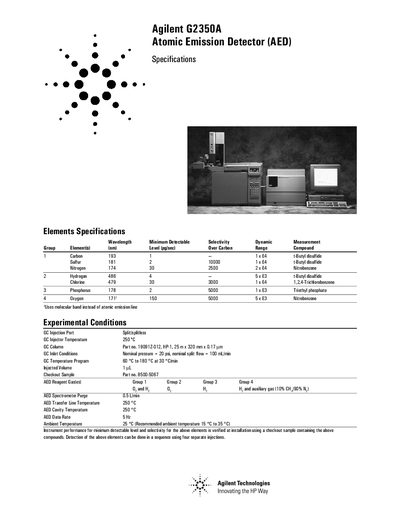
This document provides technical specifications for the Agilent G2350A Atomic Emission Detector (AED), detailing its capabilities for detecting elements such as Carbon, Sulfur, Nitrogen, Hydrogen, Chlorine, Phosphorus, and Oxygen. It includes performance data for minimum detectable levels and selectivity for various compounds.
| Wavelength Range | 171 to 837 nm |
|---|---|
| Microwave Frequency | 2,450 MHz |
| Microwave Power | 70 watts |
| Minimum Detectable Level (Carbon) | 1 pg/sec |
| Minimum Detectable Level (Sulfur) | 2 pg/sec |
| Minimum Detectable Level (Nitrogen) | 30 pg/sec |
| Minimum Detectable Level (Hydrogen) | 4 pg/sec |
| Minimum Detectable Level (Chlorine) | 30 pg/sec |
| Minimum Detectable Level (Phosphorus) | 2 pg/sec |
| Minimum Detectable Level (Oxygen) | 150 pg/sec |
| Operating Temperature | 10 °C to 40 °C |
| Data Rate | 5 Hz |
The minimum detectable level for Carbon is 1 pg/sec.
Helium gas must be 99.9999% pure for GC carrier and AED plasma.
The instrument operates in an extreme range of 10 °C to 40 °C.