
Key facts
- Brand
- Agilent
- Model
- 5973NETWORK
- Industry
- Industrial
- Documents
- 5
- Languages
- EN
- Last added
- 2012-07-05
Start here
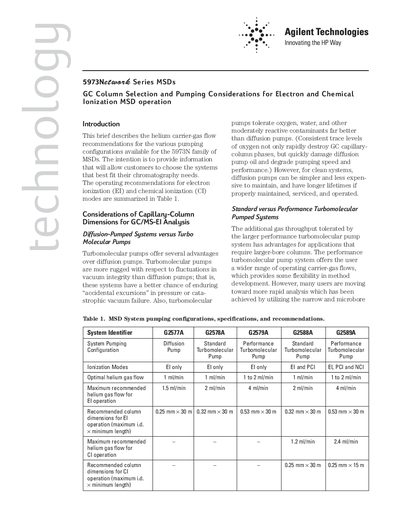
Agilent 5973Network Series MSDs GC Column selection pumping considerations for Electron Chemical Ionization MSD operation Manual
This document provides helium carrier-gas flow recommendations for the 5973N family of Mass Spectrometers (MSDs) to assist customers in selecting the appropriate pumping configuration. It compares diffusion-pumped systems versus turbomolecular pumps and distinguishes between standard and performance turbomolecular systems based on gas throughput and column requirements.
Read onlineAgilent 5973NETWORK specifications
| Optimal helium gas flow (El) | 1 ml/min |
|---|---|
| Maximum recommended helium gas flow for El operation | 1.5 ml/min |
| Recommended column dimensions for El operation | 0.25 mm x 30m |
| Maximum recommended helium gas flow for CI operation | 1.2 ml/min |
| Copyright Year | 1999 |
All Agilent 5973NETWORK documents by type
How to use the product for one specific task, with worked examples.
Questions answered in these manuals
What are the advantages of turbomolecular pumps over diffusion pumps?
Turbomolecular pumps are more rugged regarding vacuum integrity fluctuations and tolerate oxygen, water, and moderately reactive contaminants far better than diffusion pumps.
Which pumping system is recommended for GC/MS-NCI operation?
The performance turbomolecular pumping system is required for Electron-capture negative ion mass spectrometry (NCI) because buffer gas loads exceed those of reagent gas flows in PCI.
What chromatographic flow rates are compatible with the standard turbo pump MSDs?
These instruments are well-matched to chromatographic flow rates up to about 2 mL/min.
Which inner diameter columns are suitable for the standard turbo pump MSDs?
They are suitable for capillary columns with inner diameters of 0.100 mm, 0.200 mm, and 0.250 mm.
What analytical techniques can the 5973N instruments operate in?
The instruments can operate in electron impact ionization (EI) mode as well as positive and negative chemical ionization (PCI, NCI) modes.
From: Agilent 5973 Network MSD-Based GC/MS Systems Product Leaflet
What is the maximum number of MS detectors that can be configured by one ChemStation?
One ChemStation can be configured with a maximum of two MS detectors.
From: Agilent 5973 Network MSD-Based GC/MS Systems Product Leaflet