
Agilent 5973 Network MSD Ionization Methods Application Note

This document introduces the mass analysis principles and features of the 5973N high resolution mass spectrometer, including electron bombardment ionization and chemical ionization.
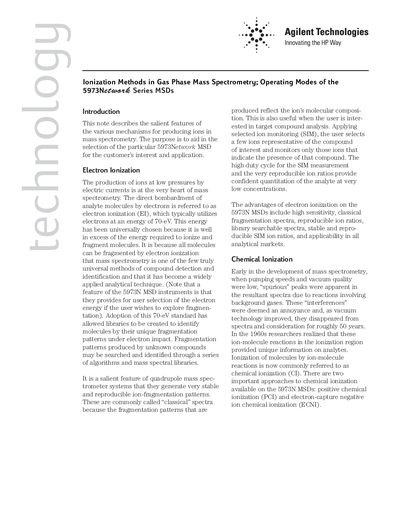

Agilent 5973 Network MSD Ionization Methods Application Note - cover page
Brand
Agilent
Category
Other
Document type
Application Note
Language
English
Pages
8
File format
PDF
File size
133 KB
Published
03 July, 2012
Updated
30 September, 2023
MD5 checksum
8F664185A987F9978E096C300B6FEFCB

About this manual

This document explains the mechanisms for producing ions in mass spectrometry, specifically focusing on Electron Ionization (EI) and Chemical Ionization (CI). It details how these methods are utilized in the 5973 Network MSD instruments to aid in the selection of the appropriate instrument for specific customer applications.

What's inside

  • Introduction
  • Electron Ionization
  • Chemical Ionization
  • Positive Chemical Ionization
  • Reagent Gases
  • Adduct Formation
  • SIM Measurement
  • Fragmentation Patterns

Frequently asked questions

What is the standard electron energy used for Electron Ionization?

The standard energy utilized for electron ionization is 70-eV.

What are the two important approaches to Chemical Ionization available on the 5973N MSDs?

The two approaches are positive chemical ionization (PCI) and electron-capture negative ion chemical ionization (ECNI).

What is the pressure range for adding reagent gas in Chemical Ionization?

Reagent gas is added to the ion source at pressures from about 0.1 Torr to 2 Torr.

Download PDF (133 KB)

More Agilent Manuals


View all Agilent manuals →