
Key facts
- Brand
- Agilent
- Model
- 7500a ICP-MS
- Documents
- 5
- Languages
- EN
- Last added
- 2012-07-05
Start here
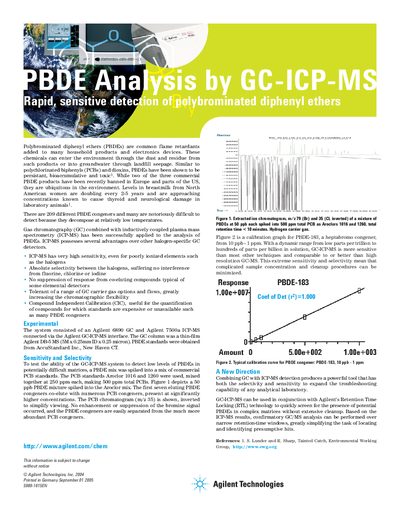
Agilent PBDE Analysis by GC-ICP-MS Technical Feature Manual
This document describes a technical application using Gas Chromatography combined with Inductively Coupled Plasma Mass Spectrometry (GC-ICP-MS) to analyze Polybrominated Diphenyl Ethers (PBDEs). The text highlights the advantages of this method, including high sensitivity for poorly ionized elements like halogens and absolute selectivity between different halogens without interference from fluorine, chlorine, or iodine.
The specific experimental setup detailed involves an Agilent 6890 GC connected to an Agilent 7500a ICP-MS via the Agilent GC-ICP-MS interface. The document discusses the system's ability to detect low levels of PBDEs in complex matrices, such as commercial PCB standards, and mentions features like Compound Independent Calibration (CIC) for quantifying compounds where standards are unavailable.
Agilent 7500a ICP-MS specifications
| Laser Spot Size | 515 um |
|---|---|
| Laser Energy | 60 % |
| Repetition Rate | 10 Hz |
| Line Speed | 30 um/s |
| Forward Power | 1350 W |
| Carrier Gas Flow | 12 L/min |
Source: Agilent 7500a ICP-MS for Nickel Alloy Production Control Application Note
All Agilent 7500a ICP-MS documents by type
How to use the product for one specific task, with worked examples.
Questions answered in these manuals
What is the total concentration of PCB standards used in the sensitivity test?
The test used a mixture of commercial PCB standards at a total concentration of 500 ppm.
From: Agilent PBDE Analysis by GC-ICP-MS Technical Feature Manual
What is the concentration range of the calibration curve for PBDE-183?
The calibration graph for PBDE-183 covers a range from 10 ppb to 1 ppm.
From: Agilent PBDE Analysis by GC-ICP-MS Technical Feature Manual
What laser system was used in this evaluation?
The study utilized the New Wave UP266 MACRO laser system.
From: Agilent 7500a ICP-MS for Nickel Alloy Production Control Application Note
Which ICP-MS instrument is recommended for this application?
The Agilent 7500a ICP-MS system was used in the evaluation.
From: Agilent 7500a ICP-MS for Nickel Alloy Production Control Application Note
What instrument was used to analyze beryllium in corundum?
The study used a Merchantek UP-213 LA system coupled to an Agilent 7500a ICP-MS.
From: Agilent 7500a ICP-MS Application Note: Analysis of Corundum Using Laser Ablation
How does the new heat treatment affect corundum?
The process involves adding beryllium during heating, which diffuses into the stone and enhances its color, making it difficult to identify as treated.
From: Agilent 7500a ICP-MS Application Note: Analysis of Corundum Using Laser Ablation