
Key facts
- Brand
- Maxim
- Model
- MAX9427
- Industry
- Industrial
- Documents
- 2
- Languages
- EN
- Last added
- 2012-06-05
Start here
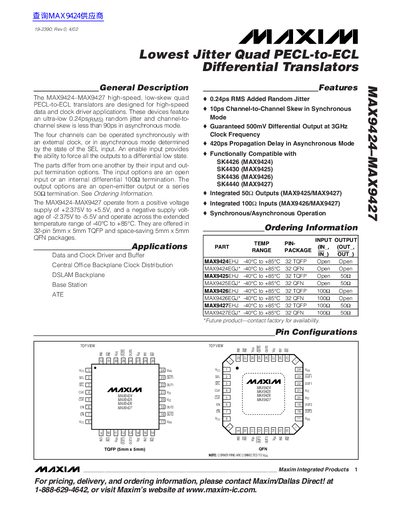
MAXIM MAX9424-MAX9427 Quad PECL-to-ECL Translator Datasheet
The MAX9424-MAX9427 are high-speed, low-skew quad PECL-to-ECL translators designed for data and clock driver applications. These devices feature ultra-low random jitter (0.24ps RMS) and can operate either synchronously with an external clock or asynchronously based on the SEL input state.
The family includes four distinct parts differentiated by their input and output termination options, ranging from open inputs/outputs to integrated 100Ω inputs and 50Ω outputs. They operate across a wide voltage range of ±2.375V to ±5.5V and are available in 32-pin TQFP and QFN packages.
Maxim MAX9427 specifications
| Added Random Jitter (RMS) | 0.24ps |
|---|---|
| Channel-to-Channel Skew (Synchronous Mode) | < 10ps |
| Maximum Clock Frequency | 3.0 GHz |
| Operating Temperature Range | -40°C to +85°C |
| Supply Voltage Range | +2.375V to +5.5V / -2.375V to -5.5V |
Source: MAXIM MAX9424-MAX9427 Quad PECL-to-ECL Translator Datasheet
All Maxim MAX9427 documents by type
Ratings, dimensions and ordering codes, for selection and design work.
Questions answered in these manuals
What is the difference between MAX9424/MAX9426 and MAX9425/MAX9427?
The parts differ by their input and output termination options; MAX9424/26 have open inputs, while MAX9425/27 have integrated 100Ω inputs.
From: MAXIM MAX9424-MAX9427 Quad PECL-to-ECL Translator Datasheet
Can the device operate in synchronous mode?
Yes, the four channels can be operated synchronously with an external clock when the SEL input is set appropriately.
From: MAXIM MAX9424-MAX9427 Quad PECL-to-ECL Translator Datasheet
What is the random jitter of the MAX9424‑MAX9427 devices?
The devices have an added random jitter of 0.24 ps RMS.
What supply voltages are required for the MAX9424‑MAX9427?
They operate from a positive supply of +2.375 V to +5.5 V and a negative supply of -2.375 V to -5.5 V.