
Key facts
- Brand
- Maxim
- Model
- MAX305
- Category
- Other Electronics
- Documents
- 6
- Languages
- EN
- Last added
- 2012-05-08
Start here
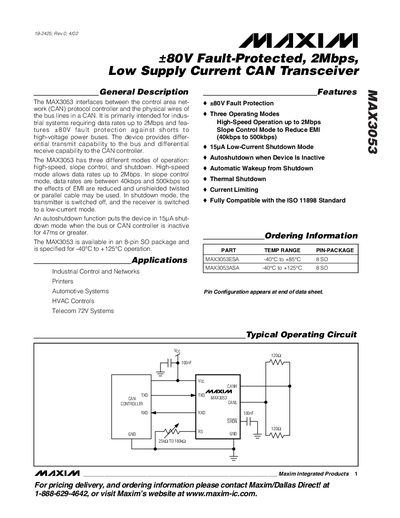
Maxim MAX3053 CAN Transceiver Datasheet
The MAX3053 CAN transceiver from Maxim provides differential transmit and receive capability for CAN bus systems. It offers three operating modes—high‑speed, slope‑control, and shutdown—and includes +80 V fault protection for high‑voltage environments.
The device operates from a single +5 V supply, drawing 56 mA in dominant state, 3.6 mA in recessive state, and only 15 µA in shutdown. It is supplied in an 8‑pin SO package and is rated for –40 °C to +125 °C operation, making it suitable for industrial, automotive, and HVAC applications.
Maxim MAX305 specifications
| Fault protection voltage | +80 V |
|---|---|
| Maximum data rate | 2 Mbps |
| Dominant supply current | 56 mA |
| Recessive supply current | 3.6 mA |
| Shutdown supply current | 15 µA |
| Operating temperature range | -40 °C to +125 °C |
All Maxim MAX305 documents by type
Ratings, dimensions and ordering codes, for selection and design work.
- Maxim MAX3053 CAN Transceiver Datasheet 11 p
- Maxim MAX3054/MAX3055/MAX3056 CAN Transceiver Datasheet 18 p
- Maxim MAX3058/MAX3059 CAN Transceiver Datasheet 12 p
- Maxim MAX3051 CAN Transceiver Datasheet 13 p
- Maxim MAX301/MAX303/MAX305 Precision Dual High-Speed Analog Switches Datasheet 8 p
- Maxim MAX3050/MAX3057 CAN Transceiver Datasheet 12 p
Questions answered in these manuals
What is the maximum data rate of the MAX3053?
The MAX3053 can operate at up to 2 Mbps in high‑speed mode.
How many operating modes does the MAX3053 support?
It supports three modes: high‑speed, slope‑control, and shutdown.
What is the maximum fault‑protected voltage for the CAN bus lines?
The transceivers are rated for a fault‑protected voltage of up to +80 V on the CANH and CANL bus lines.
From: Maxim MAX3054/MAX3055/MAX3056 CAN Transceiver Datasheet
How are the low‑power modes entered and exited?
Low‑power modes are controlled through the STB and EN pins; the INH pin can deactivate an external voltage regulator.
From: Maxim MAX3054/MAX3055/MAX3056 CAN Transceiver Datasheet
What is the common‑mode voltage range for the MAX3058?
The MAX3058 operates with a common‑mode voltage range of –7 V to +12 V.
How many operating modes does the MAX3058 support?
The MAX3058 supports four operating modes: high‑speed, slope‑control, standby, and shutdown.