
Key facts
- Brand
- Maxim
- Model
- MAX913
- Category
- Other Electronics
- Industry
- Electronics
- Documents
- 2
- Languages
- EN
- Last added
- 2012-05-08
Start here
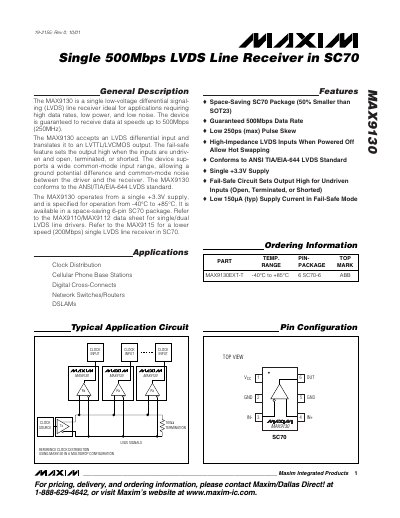
Maxim MAX9130 LVDS Line Receiver Datasheet
The MAX9130 is a single low‑voltage differential signal (LVDS) line receiver designed for high‑speed data transmission, low power consumption, and low noise. It operates from a single +3.3 V supply, supports data rates up to 500 Mbps (250 MHz), and includes a fail‑safe circuit that forces the output high when inputs are undriven, open, terminated, or shorted.
The datasheet provides absolute maximum ratings, DC and AC electrical characteristics, pin descriptions, recommended board layout, termination practices, and typical application circuits. It also details supply current in fail‑safe mode (150 µA) and normal operation (7 mA), as well as propagation delay, rise/fall times, and recommended 100 Ω termination.
Maxim MAX913 specifications
| Maximum Data Rate | 500 Mbps (250 MHz) |
|---|---|
| Supply Voltage | +3.3 V (range +3.0 V to +3.6 V) |
| Operating Temperature Range | -40 °C to +85 °C |
| Package | 6‑pin SC70 |
| Normal Supply Current | 7 mA |
| Typical Propagation Delay (high‑to‑low) | 1.8 ns |
| Rise Time (typical) | 0.5 ns |
All Maxim MAX913 documents by type
Ratings, dimensions and ordering codes, for selection and design work.
Questions answered in these manuals
What is the typical propagation delay of the MAX913 comparator?
The MAX913 has a typical propagation delay of 10 ns.
From: Maxim MAX912/MAX913 Ultra-Fast Low-Power Precision TTL Comparator Datasheet
What supply voltage options are available for the MAX912/MAX913?
They can be powered from a single +5 V supply or a ±5 V split supply.
From: Maxim MAX912/MAX913 Ultra-Fast Low-Power Precision TTL Comparator Datasheet