
MAX9424-MAX9427 are high-speed, low-skew quad PECL to ECL translators designed for high-speed data and clock driver applications. These devices feature an ultra-low 0.24ps(RMS) random jitter and channel-to-channel skew is less than 90ps in asynchronous mode. The four channels can be operated synchronously with an external clock, or in asynchronous mode determined by the state of the SEL input. An enable input provides the ability to force all the outputs to a differential low state. The parts differ from one another by their input and output termination options. The input options are an open input or an internal differential 100Ω termination. The output options are an open-emitter output or a series 50Ω termination. See Ordering Information. MAX9424-MAX9427 operate from a positive voltage supply of +2.375V to +5.5V, and a negative supply voltage of -2.375V to -5.5V and operate across the extended temperature range of -40°C to +85°C. They are offered in 32-pin 5mm x 5mm TQFP and space-saving 5mm x 5mm QFN packages. Applications include data and clock driver and buffer, central office backplane clock distribution, DSLAM backplane, base station, and ATE. Features include 0.24ps RMS Added Random Jitter, 10ps Channel-to-Channel Skew in Synchronous Mode, Guaranteed 500mV Differential Output at 3GHz Clock Frequency, 420ps Propagation Delay in Asynchronous Mode, Functionally Compatible with SK4426 (MAX9424), SK4430 (MAX9425), SK4436 (MAX9426), SK4440 (MAX9427), and Integrated Circuits.
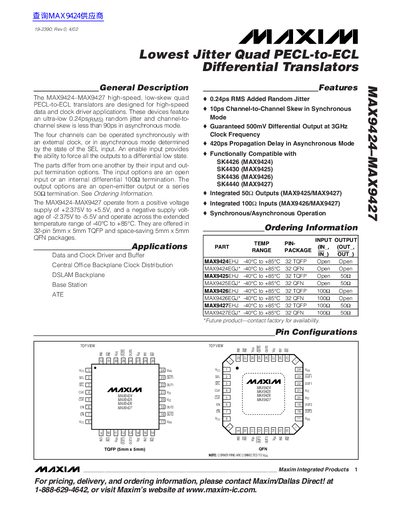
The MAX9424-MAX9427 are high-speed, low-skew quad PECL-to-ECL translators designed for data and clock driver applications. These devices feature ultra-low random jitter (0.24ps RMS) and can operate either synchronously with an external clock or asynchronously based on the SEL input state.
The family includes four distinct parts differentiated by their input and output termination options, ranging from open inputs/outputs to integrated 100Ω inputs and 50Ω outputs. They operate across a wide voltage range of ±2.375V to ±5.5V and are available in 32-pin TQFP and QFN packages.
| Added Random Jitter (RMS) | 0.24ps |
|---|---|
| Channel-to-Channel Skew (Synchronous Mode) | < 10ps |
| Maximum Clock Frequency | 3.0 GHz |
| Operating Temperature Range | -40°C to +85°C |
| Supply Voltage Range | +2.375V to +5.5V / -2.375V to -5.5V |
The parts differ by their input and output termination options; MAX9424/26 have open inputs, while MAX9425/27 have integrated 100Ω inputs.
Yes, the four channels can be operated synchronously with an external clock when the SEL input is set appropriately.
The devices are offered in 32-pin 5mm x 5mm TQFP and space-saving 5mm x 5mm QFN packages.