
Key facts
- Brand
- Maxim
- Model
- MAX19995
- Category
- Other Electronics
- Documents
- 2
- Languages
- EN
- Last added
- 2012-05-07
Start here
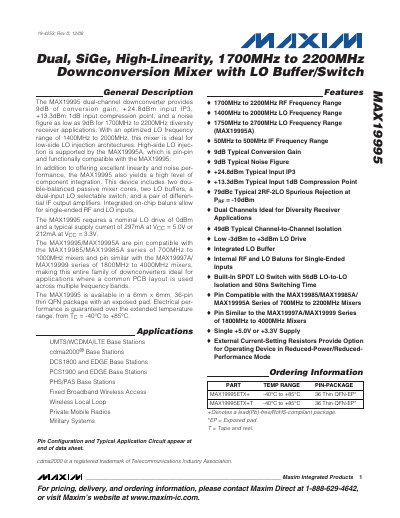
Maxim MAX19995 Dual-Channel Downconverter Data Sheet
The MAX19995 dual‑channel downconverter provides 9 dB of conversion gain, +24.8 dBm input IP3, and a typical noise figure of 9 dB for 1700 MHz‑2200 MHz diversity receiver applications. It integrates two double‑balanced passive mixer cores, LO buffers, a selectable LO switch, and differential IF output amplifiers, with on‑chip baluns for single‑ended RF and LO inputs.
The device operates from a 3.3 V or 5.0 V supply, drawing 212 mA (3.3 V) or 297 mA (5.0 V). It is offered in a 6 mm × 6 mm, 36‑pin thin QFN‑EP package and is rated for –40 °C to +85 °C operation. Pin‑compatible families cover 700 MHz‑1000 MHz and 1800 MHz‑4000 MHz mixer ranges, enabling flexible PCB reuse across multiple frequency bands.
Maxim MAX19995 specifications
| RF Frequency Range | 1700 MHz – 2200 MHz |
|---|---|
| LO Frequency Range (low‑side) | 1400 MHz – 2000 MHz |
| LO Frequency Range (high‑side, MAX19995A) | 1750 MHz – 2700 MHz |
| IF Frequency Range | 50 MHz – 500 MHz |
| Typical Conversion Gain | 9 dB |
| Typical Noise Figure | 9 dB |
| Typical Input IP3 | +24.8 dBm |
| Typical Input 1 dB Compression | +13.3 dBm |
| Supply Voltage | 3.3 V – 5.0 V |
| Channel‑to‑Channel Isolation | 49 dB |
| LO Drive Level | -3 dBm to +3 dBm |
| Package | 6 mm × 6 mm, 36‑pin thin QFN‑EP |
Source: Maxim MAX19995 Dual-Channel Downconverter Data Sheet
All Maxim MAX19995 documents by type
Ratings, dimensions and ordering codes, for selection and design work.
Questions answered in these manuals
What is the typical conversion gain of the MAX19995?
The typical conversion gain is 9 dB.
What supply voltage range does the MAX19995 support?
It can be powered from 3.3 V up to 5.0 V.
What is the typical conversion gain of the MAX19995A?
The MAX19995A provides a typical conversion gain of 8.7 dB.
How much supply current does the MAX19995A draw at 5 V?
At a 5 V supply the device draws about 350 mA of current.