
Key facts
- Brand
- Maxim
- Model
- MAX9320
- Documents
- 2
- Languages
- EN
- Last added
- 2012-05-08
Start here
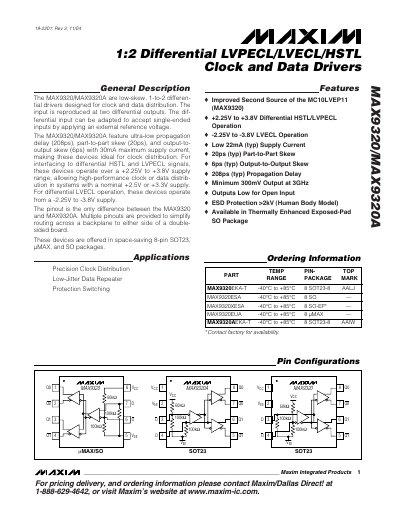
Maxim MAX9320/MAX9320A Differential Driver Datasheet
The MAX9320 and MAX9320A are differential drivers designed for high‑performance clock and data distribution. They accept differential inputs and can be adapted for single‑ended inputs using an external reference voltage. The devices operate from +2.25 V to +3.8 V for HSTL/LVPECL and from –2.25 V to –3.8 V for LVECL, making them suitable for a range of high‑speed signaling standards.
Key features include an ultra‑low typical propagation delay of 208 ps, part‑to‑part skew of 20 ps, output‑to‑output skew of 6 ps, and low supply current (typical 22 mA). The parts are offered in compact 8‑pin SOT23‑8, µMAX, and SO packages with exposed‑pad options for improved thermal performance.
Maxim MAX9320 specifications
| Typical propagation delay | 208 ps |
|---|---|
| Typical part‑to‑part skew | 20 ps |
| Typical output‑to‑output skew | 6 ps |
| Supply voltage range (HSTL/LVPECL) | +2.25 V to +3.8 V |
| Supply voltage range (LVECL) | -2.25 V to -3.8 V |
| Operating temperature range | -40 °C to +85 °C |
| Maximum output voltage swing | ≥ 300 mV at 3 GHz |
Source: Maxim MAX9320/MAX9320A Differential Driver Datasheet
All Maxim MAX9320 documents by type
Ratings, dimensions and ordering codes, for selection and design work.
Questions answered in these manuals
What is the typical propagation delay of the MAX9320?
The typical propagation delay is 208 ps.
What supply voltage ranges does the MAX9320 support?
It operates from +2.25 V to +3.8 V for HSTL/LVPECL and from –2.25 V to –3.8 V for LVECL.
What is the typical propagation delay of the MAX9320B?
The typical propagation delay is 208 ps.
What supply current does the MAX9320B draw at maximum?
The device draws up to 30 mA of supply current.