
Key facts
- Brand
- Maxim
- Model
- DS2155
- Category
- Other Electronics
- Documents
- 3
- Languages
- EN
- Last added
- 2012-07-03
Start here
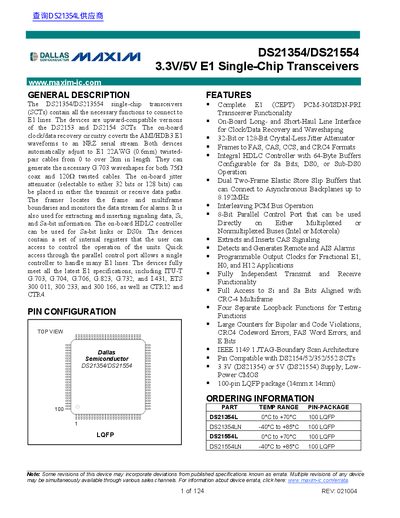
Maxim DS21354/DS21554 E1 Single-Chip Transceivers Datasheet
The DS21354 and DS21554 are single-chip transceivers (SCTs) designed to connect to E1 lines. These devices contain all necessary functions for PCM-30/ISDN-PRI transceiver functionality, including on-board clock/data recovery and waveshaping circuits. They support twisted-pair cables up to 2km in length and can generate G.703 waveshapes for both coaxial and twisted pair cables.
Read onlineMaxim DS2155 specifications
| Supply Voltage | 3.3V (DS21354) or 5V (DS21554) |
|---|---|
| Package Type | 100-pin LQFP |
| Operating Temperature Range | -40°C to +85°C |
| Jitter Attenuator Size | 32-Bit or 128-Bit |
Source: Maxim DS21354/DS21554 E1 Single-Chip Transceivers Datasheet
All Maxim DS2155 documents by type
Ratings, dimensions and ordering codes, for selection and design work.
Questions answered in these manuals
What is the pin configuration for these transceivers?
The devices are available in a 100-pin LQFP package measuring 14mm x 14mm.
From: Maxim DS21354/DS21554 E1 Single-Chip Transceivers Datasheet
Do these transceivers support ISDN?
Yes, they provide complete E1 CEPT PCM-30/ISDN-PRI Transceiver Functionality.
From: Maxim DS21354/DS21554 E1 Single-Chip Transceivers Datasheet
What is the difference between DS21352 and DS21552?
The primary difference is the supply voltage; DS21352 operates at 3.3V while DS21552 operates at 5V.
From: Maxim DS21352/DS21552 T1 Single-Chip Transceivers Datasheet
Does the device support crystal-less operation?
Yes, it includes a crystal-less jitter attenuator.
From: Maxim DS21352/DS21552 T1 Single-Chip Transceivers Datasheet
What line interfaces does the DS2155 support?
The device supports T1, E1, and J1 line protocols as a single‑chip transceiver.
What clock output frequencies can the DS2155 generate?
It can synthesize clock outputs of 16.384 MHz, 8.192 MHz, 4.096 MHz, or 2.048 MHz.