
Key facts
- Brand
- Maxim
- Model
- MAX104
- Industry
- Industrial
- Documents
- 3
- Languages
- EN
- Last added
- 2012-07-10
Start here
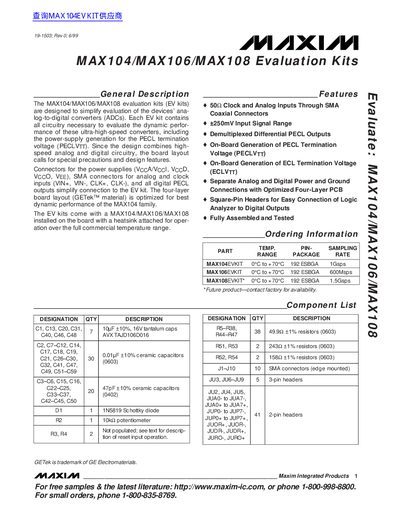
Maxim MAX104/MAX106/MAX108 Evaluation Kits
The document details the MAX104/MAX106/MAX108 Evaluation Kits (EV kits), which are designed to simplify the evaluation of the dynamic performance of these ultra-high-speed analog-to-digital converters (ADCs). Each kit contains all necessary circuitry, including power-supply generation for PECL termination voltage, and features a four-layer board layout optimized for high-speed analog and digital circuitry. The kits come fully assembled and tested with the respective ADC installed on the board with a heatsink.
Read onlineMaxim MAX104 specifications
| Conversion Rate | 1Gsps |
|---|---|
| Resolution | 8-bit |
| Analog Input Bandwidth | 2.2GHz |
| Effective Bits at Nyquist Frequency | >7.5 |
| Input Voltage Range | ±250mV |
| Package Type | 192-Contact ESBGA |
| Operating Temperature Range | 0°C to +70°C |
All Maxim MAX104 documents by type
Ratings, dimensions and ordering codes, for selection and design work.
Questions answered in these manuals
What is the input signal range for the evaluation kits?
The input signal range is +250mV.
Do the kits include the ADC installed on the board?
Yes, the EV kits come with a MAX104/MAX106/MAX108 installed on the board with a heatsink attached.
What is the maximum sampling rate of the MAX104?
The device supports a conversion rate of 1 Gsps.
What is the full-power input bandwidth of the analog signal?
The ADC provides an exceptionally wide 2.2GHz full-power input bandwidth.
What is the maximum sampling rate of the MAX104?
The MAX104 can sample at up to 1 Gsps.
What analog input bandwidth does the MAX104 provide?
It offers a full‑power analog input bandwidth of 2.2 GHz.