
Key facts
- Brand
- Analog Devices
- Model
- AD5755
- Industry
- Industrial
- Documents
- 2
- Languages
- EN
- Last added
- 2012-05-09
Start here
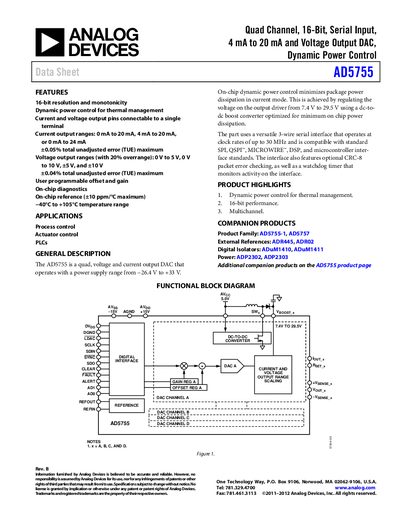
Analog Devices AD5755 Datasheet
The AD5755 is a quad‑channel DAC that provides both voltage and current outputs with 16‑bit resolution. It operates from a wide power‑supply range (‑26.4 V to +33 V) and includes on‑chip dynamic power control to reduce thermal dissipation. The device uses a versatile 3‑wire serial interface compatible with SPI, QSPI, Microwire, DSP and microcontroller standards, and offers optional CRC‑8 error checking and a watchdog timer.
Typical applications include process control, actuator control, and PLCs. The datasheet details functional block diagrams, pin configurations, timing characteristics, and extensive performance specifications such as output voltage ranges, current ranges, accuracy, and noise figures.
Analog Devices AD5755 specifications
| Resolution | 16 Bits |
|---|---|
| Output Voltage Ranges | 0‑5 V, 0‑10 V, –5 V to +5 V, –10 V to +10 V |
| Total Unadjusted Error (typical) | ±0.04 % FSR |
| Current Output Range | 0‑24 mA |
| Power‑Supply Range | ‑26.4 V to +33 V |
| Operating Temperature Range | ‑40 °C to +105 °C |
| Serial Interface Clock Rate | up to 30 MHz |
| On‑chip Reference Accuracy | ±10 ppm/°C |
Source: Analog Devices AD5755 Datasheet
All Analog Devices AD5755 documents by type
Ratings, dimensions and ordering codes, for selection and design work.
Questions answered in these manuals
What is the power‑supply voltage range for the AD5755?
The AD5755 operates from –26.4 V to +33 V.
How many bits of resolution does the AD5755 provide?
It provides 16‑bit resolution.
What serial interface does the AD5755 support?
The AD5755 uses a 3‑wire serial interface compatible with standard SPI, QSPI, MICROWIRE, DSP and microcontroller interfaces, with optional CRC‑8 error checking and a watchdog timer.
How does the dynamic power control work?
Dynamic power control minimizes package power dissipation by regulating the voltage on the output driver from 7.4 V to 29.5 V using an on‑chip DC‑to‑DC boost converter.