
Application of Collision/Reaction Cell ICP-MS to the Analysis of Variable and Unknown Samples Without Requiring Matrix-Specific or Element-Specific Tuning and Cell Conditions Cell Operation with an Inert Cell Gas Using an inert cell gas and efficient energy discrimination (ED) removes all of these reported problems, since the cell is operating as a non-reactive environment. The use of an inert gas allows ED to be used as the primary interference removal process, which eliminates the method development inherent in the use of reactive cell gases. This means that the analysis conditions are independent of the analyte being measured (and of the interferences being removed), multi- element analysis is possible and the operating conditions do not have to be optimised for each matrix type. A further benefit of collision mode is that no interference correction equations are necessary. Use of ED depends on the use of a high purity inert cell gas, which is free from organic contaminants and water vapour, so plumbing of the gas supply requires care. A light collision gas (He) is preferred, since less analyte ion scattering occurs. Introduction. ICP-MS is a multi-element analytical technique, which uses a high temperature plasma source to decompose, dissociate, atomise and ionise the elements of interest in a sample, providing high sensitivity, rapid analysis, low detection limits, simple spectra and routine operation. In simple solutions, few interferences obscure the measurement of the
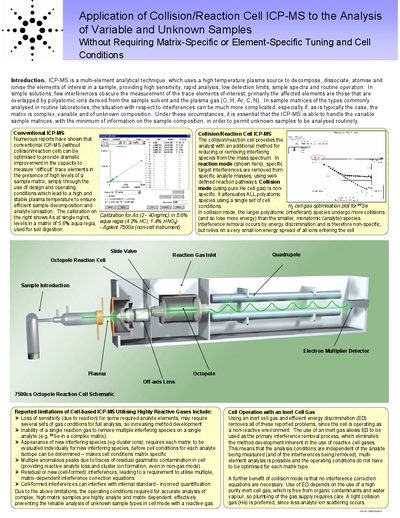
This document describes the application of Collision/Reaction Cell ICP-MS for analyzing variable and unknown samples. It explains how the collision/reaction cell provides an additional method for reducing or removing interfering species from the mass spectrum, allowing for the measurement of difficult trace elements in complex matrices.
The collision/reaction cell provides an additional method for reducing or removing interfering species from the mass spectrum to allow the measurement of difficult trace elements in complex sample matrices.
Effective operation requires a shielded torch configuration to provide a much smaller ion energy spread than unshielded torch configurations.