
Key facts
- Brand
- Maxim
- Model
- MAX412
- Industry
- Industrial
- Documents
- 3
- Languages
- EN
- Last added
- 2012-05-08
Start here
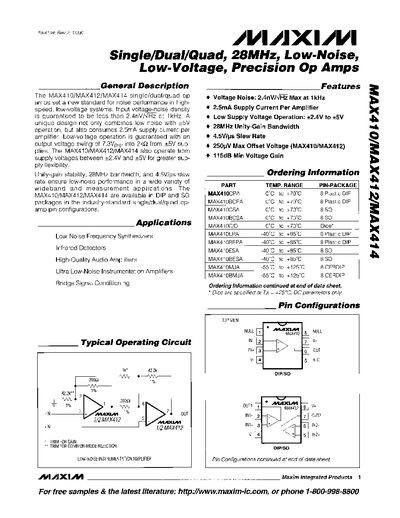
Maxim MAX410/MAX412/MAX414 Datasheet
The MAX410, MAX412 and MAX414 are single‑, dual‑ and quad‑package operational amplifiers designed for high‑speed, low‑voltage systems. They offer a very low input voltage‑noise density (≤ 2.4 nV/√Hz at 1 kHz) while operating from a supply range of +2.4 V to +5 V and drawing only 2.5 mA per amplifier.
Key electrical characteristics include a 28 MHz unity‑gain bandwidth, 4.5 V/µs slew rate, 7.3 Vpp output swing into a 2 kΩ load, and robust protection features such as a 35 mA short‑circuit output current limit. The devices are supplied in DIP, SO and CERDIP packages and are suited for low‑noise frequency synthesizers, audio amplifiers, instrumentation, and bridge signal‑conditioning circuits.
Maxim MAX412 specifications
| Voltage Noise Density | ≤ 2.4 nV/√Hz at 1 kHz |
|---|---|
| Supply Current per Amplifier | 2.5 mA |
| Supply Voltage Range | +2.4 V to +5 V |
| Unity‑Gain Bandwidth | 28 MHz |
| Slew Rate | 4.5 V/µs |
| Output Voltage Swing | 7.3 Vpp into 2 kΩ |
| Short‑Circuit Output Current | 35 mA |
All Maxim MAX412 documents by type
Ratings, dimensions and ordering codes, for selection and design work.
Questions answered in these manuals
What is the voltage noise density of the MAX410/MAX412/MAX414?
The voltage noise density is guaranteed to be less than 2.4 nV/√Hz at 1 kHz.
What supply voltage range can these op‑amps operate from?
They operate from +2.4 V up to +5 V, providing flexibility for low‑voltage designs.
How much supply current does each amplifier draw?
Each amplifier consumes about 2.5 mA of supply current.
What is the maximum capacitive load the op‑amp can drive stably?
The op‑amp remains stable driving capacitive loads up to 3900 pF.
What supply voltage range do the MAX410/MAX412/MAX414 support?
They operate from +2.4 V up to +5 V (up to +5.25 V in some specifications).
What is the typical voltage‑noise density of these op‑amps?
The typical voltage‑noise density is 2.4 nV/√Hz at 1 kHz.