
The MAX410/MAX412/MAX414 single/dual/quad op amps set a new standard for noise performance in high-speed, low-voltage systems. Input voltage-noise density is guaranteed to be less than 2.4nV/√Hz at 1kHz. A unique design not only combines low noise with ±5V operation, but also consumes 2.5mA supply current per amplifier. Low-voltage operation is guaranteed with an output voltage swing of 7.3VP-P into 2kΩ from ±5V supplies. The MAX410/MAX412/MAX414 also operate from supply voltages between ±2.4V and ±5V for greater supply flexibility. Unity-gain stability, 28MHz bandwidth, and 4.5V/µs slew rate ensure low-noise performance in a wide variety of wideband and measurement applications. The MAX410/MAX412/MAX414 are available in DIP and SO packages in the industry-standard single/dual/quad op amp pin configurations. The single comes in an ultra-small TDFN package (3mm ✕ 3mm).
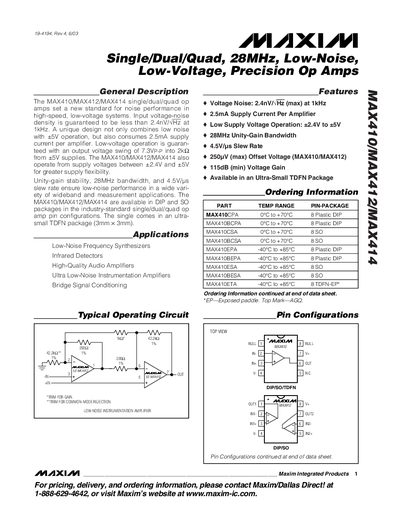
The MAX410, MAX412, and MAX414 are single, dual, and quad precision operational amplifiers designed for high‑speed, low‑voltage systems. They offer a voltage‑noise density of less than 2.4 nV/√Hz at 1 kHz, a supply current of 2.5 mA per amplifier, and an output swing of 7.3 V p‑p into a 2 kΩ load from a +5 V supply. The devices operate from +2.4 V to +5 V and feature a 28 MHz unity‑gain bandwidth and a 4.5 V/µs slew rate.
Typical applications include low‑noise frequency synthesizers, infrared detectors, high‑quality audio amplifiers, ultra‑low‑noise instrumentation amplifiers, and bridge signal conditioning. The datasheet lists available DIP, SO, and ultra‑small TDFN packages, detailed absolute‑maximum ratings, electrical characteristics, and typical operating curves to aid designers in selecting and using these op‑amps.
| Voltage‑Noise Density (max) | 2.4 nV/√Hz at 1 kHz |
|---|---|
| Supply Current per Amplifier | 2.5 mA |
| Supply Voltage Range | +2.4 V to +5 V |
| Unity‑Gain Bandwidth | 28 MHz |
| Slew Rate | 4.5 V/µs |
| Offset Voltage (MAX410/MAX412) | ≤ 250 µV |
| Voltage Gain (minimum) | 115 dB |
They operate from +2.4 V up to +5 V (up to +5.25 V in some specifications).
The typical voltage‑noise density is 2.4 nV/√Hz at 1 kHz.
The unity‑gain bandwidth is 28 MHz.