
Key facts
- Brand
- Maxim
- Model
- MAX388
- Industry
- Industrial
- Documents
- 2
- Languages
- EN
- Last added
- 2012-06-04
Start here
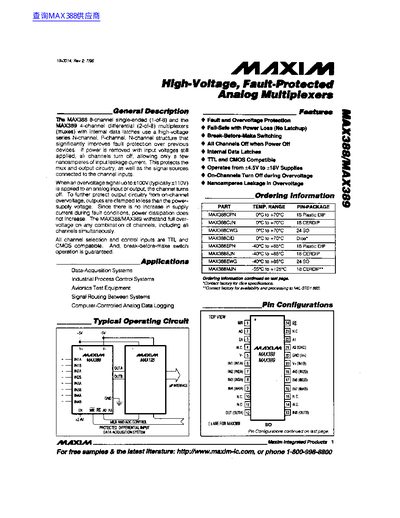
Maxim MAX388/MAX389 Analog Multiplexer Datasheet
The MAX388 and MAX389 are high‑voltage, fault‑protected analog multiplexers that use a series N‑channel/P‑channel FET structure to limit leakage and protect both the device and connected signal sources. They turn off all channels when power is removed, allowing only nanoampere‑level leakage even with input voltages up to +100 V.
These devices operate from +4.5 V to +18 V supplies, support TTL and CMOS logic levels, and provide break‑before‑make switching with typical 600 ns channel‑to‑channel transition time. They are suited for data‑acquisition systems, industrial process control, avionics test equipment, and signal routing between systems.
All Maxim MAX388 documents by type
Ratings, dimensions and ordering codes, for selection and design work.
Questions answered in these manuals
What over‑voltage level does the MAX388/MAX389 protect against?
The devices turn off a channel when an over‑voltage signal up to +100 V is applied to an analog input or output.
What is the typical switching time of the multiplexers?
Channel‑to‑channel switching time is typically 600 ns, including about 200 ns of break‑before‑make delay.
What is the maximum voltage the MAX388 can tolerate?
The MAX388 can tolerate an over‑voltage of up to ±100 V on its analog inputs, after which the channel turns off.
From: Maxim MAX388/MAX389 High‑Voltage Fault‑Protected Analog Multiplexer Datasheet
How many channels does the MAX389 have?
The MAX389 is a 4‑channel differential (2‑of‑8) analog multiplexer.
From: Maxim MAX388/MAX389 High‑Voltage Fault‑Protected Analog Multiplexer Datasheet