
Key facts
- Brand
- Analog Devices
- Model
- ADXL320
- Industry
- Industrial
- Documents
- 2
- Languages
- EN
- Last added
- 2012-06-04
Start here
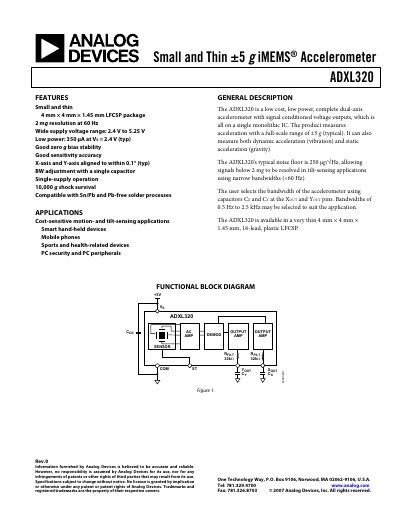
Analog Devices ADXL320 Accelerometer Handbook
The ADXL320 is a low‑cost, low‑power dual‑axis accelerometer with signal‑conditioned voltage outputs, offered in a thin 4 mm × 4 mm × 1.45 mm LFCSP package. It measures acceleration over a full‑scale range of ±5 g and can detect both dynamic (vibration) and static (gravity) acceleration.
The document includes detailed specifications, absolute maximum ratings, pin descriptions, performance charts, bandwidth setting using external capacitors, self‑test procedures, tilt‑sensor operation, mechanical dimensions, and ordering information.
Analog Devices ADXL320 specifications
| Measurement Range | ±5 g |
|---|---|
| Sensitivity (typical) | 156‑192 mV/g |
| Zero‑g Bias Level | 1.3‑1.7 V |
| Noise Density | 250 µg/√Hz rms |
| Operating Voltage Range | 2.4 V to 5.25 V |
| Quiescent Supply Current | 0.48 mA |
| Operating Temperature Range | −20 °C to 70 °C |
All Analog Devices ADXL320 documents by type
Ratings, dimensions and ordering codes, for selection and design work.
Questions answered in these manuals
What is the full‑scale measurement range of the ADXL320?
The ADXL320 measures acceleration over a full‑scale range of ±5 g.
What is the typical noise floor of the ADXL320?
The typical noise density is 250 µg/√Hz at 25 °C.
What is the measurement range of the ADXL320?
The ADXL320 measures acceleration over a range of ±5 g.
What supply voltage does the ADXL320 require?
It operates from 2.4 V up to 5.25 V.