
Key facts
- Brand
- Analog Devices
- Model
- ADXL213
- Industry
- Industrial
- Documents
- 2
- Languages
- EN
- Last added
- 2012-05-05
Start here
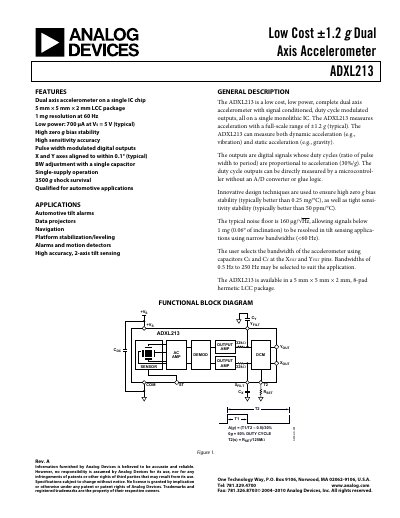
Analog Devices ADXL213 Dual Axis Accelerometer Datasheet
The ADXL213 provides dual‑axis acceleration measurement on a single 5 mm × 5 mm × 2 mm LCC package. It outputs duty‑cycle‑modulated digital signals proportional to acceleration, allowing direct reading by a microcontroller without an ADC. The device operates from 3 V to 6 V, consumes 0.7–1.1 mA, and offers selectable bandwidths from 0.5 Hz to 250 Hz via external capacitors.
Automotive‑qualified models (ADXL213W) are available, and the part meets a 3500 g shock rating and a temperature range of –55 °C to +125 °C. Typical applications include tilt alarms, navigation, platform stabilization, and motion detection.
Analog Devices ADXL213 specifications
| Measurement Range | ±1.2 g per axis |
|---|---|
| Sensitivity (typical at 5 V) | 27 %/g |
| Zero‑g bias level | ±50 % (ratiometric) |
| Operating Voltage Range | 3 V to 6 V |
| Quiescent Supply Current | 0.7 mA to 1.1 mA |
| Bandwidth (selectable) | 0.5 Hz to 250 Hz |
| Shock Survival | 3500 g |
| Operating Temperature Range | –55 °C to +125 °C |
Source: Analog Devices ADXL213 Dual Axis Accelerometer Datasheet
All Analog Devices ADXL213 documents by type
Ratings, dimensions and ordering codes, for selection and design work.
Questions answered in these manuals
What supply voltage range does the ADXL213 support?
The ADXL213 operates from 3 V up to 6 V.
From: Analog Devices ADXL213 Dual Axis Accelerometer Datasheet
How is the bandwidth of the ADXL213 set?
Bandwidth is set by adding external capacitors Cx and Cy at the filter pins; the -3 dB bandwidth equals 1/(2π·32 kΩ·C).
From: Analog Devices ADXL213 Dual Axis Accelerometer Datasheet
What is the measurement range of the ADXL213?
The device measures acceleration up to +1.2 g.
What is the typical noise density of the ADXL213?
The typical noise density is 160 µg/V·Hz rms at 25 °C.