
Key facts
- Brand
- Analog Devices
- Model
- AD5371
- Industry
- Industrial
- Documents
- 2
- Languages
- EN
- Last added
- 2012-05-09
Start here
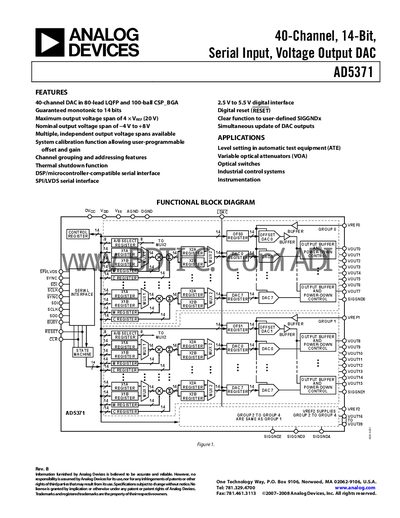
Analog Devices AD5371 Handbook
The AD5371 is a 40‑channel, 14‑bit digital‑to‑analog converter offered in 80‑lead LQFP and 100‑ball CSP‑BGA packages. It features buffered voltage outputs with programmable gain and offset, multiple independent output spans, and a high‑speed serial interface compatible with SPI, LVDS, and DSP standards.
The document includes a functional block diagram, detailed specifications, timing characteristics, power‑supply recommendations, and example interfacing circuits for DSPs and microcontrollers. It also covers calibration, power‑down, thermal shutdown, and layout guidelines to ensure accurate performance.
Analog Devices AD5371 specifications
| Resolution | 14 bits |
|---|---|
| Integral Nonlinearity (INL) | -1 to +1 LSB |
| Differential Nonlinearity (DNL) | -1 to +1 LSB |
| Gain Error | 0.1 % FSR |
| Output Voltage Range | -4 V to +8 V |
| Supply Voltage (DVcc) | 2.5 V to 5.5 V |
| Short‑Circuit Current | 15 mA |
| Power Dissipation (unloaded) | 280 mW |
| Maximum SPI Clock Speed | 50 MHz |
| Number of Channels | 40 |
Source: Analog Devices AD5371 Datasheet
All Analog Devices AD5371 documents by type
Ratings, dimensions and ordering codes, for selection and design work.
Day-to-day operation, settings and troubleshooting. Start here if the product is already set up.
Questions answered in these manuals
How many channels does the AD5371 have?
The AD5371 provides 40 independent DAC channels.
What is the output voltage range of the AD5371?
The nominal output voltage range is –4 V to +8 V.
What is the maximum serial interface clock speed for the AD5371?
The device can handle clock speeds of up to 50 MHz.
How many DAC channels does the AD5371 provide?
The AD5371 contains 40 independent 14‑bit DAC channels.