
Key facts
- Brand
- Analog Devices
- Model
- AD1892
- Industry
- Industrial
- Documents
- 2
- Languages
- EN
- Last added
- 2012-06-04
Start here
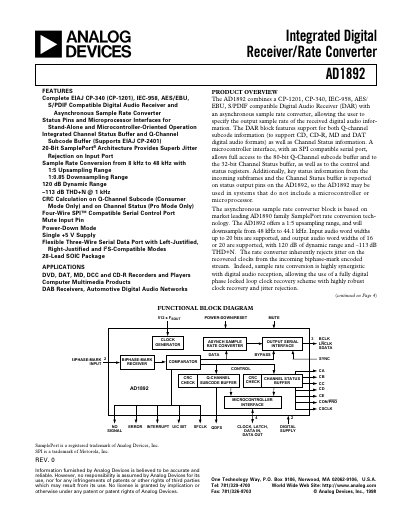
Analog Devices AD1892 Integrated Digital Receiver/Rate Converter Datasheet
The AD1892 combines a fully compatible digital audio receiver (DAR) with an asynchronous sample‑rate converter, supporting EIAJ CP‑340, IEC‑958, AES/EBU and S/PDIF standards. It provides Q‑Channel subcode and Channel Status buffers, a 20‑bit SamplePort® architecture, and a flexible SPI‑compatible serial control interface for microcontroller‑oriented operation.
The device operates from a single +5 V supply, offers a 1:5 up‑sampling range (8 kHz → 48 kHz) and down‑sampling to 44.1 kHz, delivers 120 dB dynamic range with –113 dB THD+N, and is available in a 28‑lead SOIC package suitable for industrial temperature ranges (‑40 °C to +85 °C).
Analog Devices AD1892 specifications
| Supply Voltage (DVDD) | 4.5 V – 5.5 V |
|---|---|
| Operational Current | 50 mA – 60 mA |
| THD+N (1 kHz Full‑Scale Input) | –113 dB |
| Sample‑Rate Conversion Range | 8 kHz → 48 kHz (1:5 up‑sampling), 48 kHz → 44.1 kHz (down‑sampling) |
| Input Word Width | up to 20 bits |
| Package | 28‑lead SOIC |
Source: Analog Devices AD1892 Integrated Digital Receiver/Rate Converter Datasheet
All Analog Devices AD1892 documents by type
Ratings, dimensions and ordering codes, for selection and design work.
Questions answered in these manuals
What supply voltage does the AD1892 require?
The AD1892 operates from a single +5 V supply, with a voltage range of 4.5 V to 5.5 V.
From: Analog Devices AD1892 Integrated Digital Receiver/Rate Converter Datasheet
Which digital audio standards are supported?
It is compatible with EIAJ CP‑340, IEC‑958, AES/EBU and S/PDIF.
From: Analog Devices AD1892 Integrated Digital Receiver/Rate Converter Datasheet
What supply voltage does the AD1892 require?
The AD1892 operates from a single +5 V nominal supply.
How can multiple AD1892 devices be synchronized?
Multiple AD1892s can be synchronized by connecting their SYNC input (Pin 23) to a common LEFT/RIGHT clock.