
Key facts
- Brand
- Maxim
- Model
- MAX2043
- Industry
- Industrial
- Documents
- 3
- Languages
- ZH · EN
- Last added
- 2012-05-07
Start here
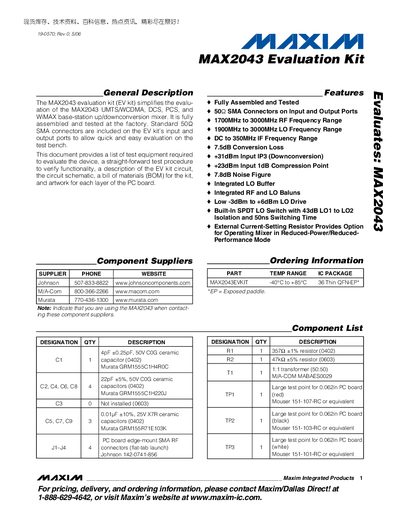
Maxim MAX2043 Evaluation Kit User Manual
The MAX2043 Evaluation Kit is a fully assembled, factory‑tested board that simplifies evaluation of the MAX2043 UMTS/WCDMA, DCS, PCS, and WiMAX base‑station up/down‑conversion mixer. It includes 502 SMA connectors on the input and output ports and covers RF frequencies from 1700 MHz to 3000 MHz, LO frequencies from 1900 MHz to 3000 MHz, and IF frequencies from DC to 350 MHz.
The manual contains a quick‑start guide, a list of required test equipment, detailed connection and setup procedures, mixer testing steps, layout considerations, and a complete schematic and PCB layout. Component part numbers, ordering information, and a bill of materials are also provided.
Maxim MAX2043 specifications
| RF Frequency Range | 1700 MHz – 3000 MHz |
|---|---|
| LO Frequency Range | 1900 MHz – 3000 MHz |
| IF Frequency Range | DC – 350 MHz |
| Conversion Loss | 7.5 dB (typical) |
| Noise Figure | 7.8 dB (typical) |
| 3rd‑Order Input Intercept Point (IIP3) | +31 dBm |
| LO Leakage (RF Port) | -52 dBm |
| Supply Voltage | 4.75 V – 5.25 V |
| Supply Current | 108 mA (typical) |
| Operating Temperature | -40 °C to +85 °C |
Source: Maxim MAX2043 High-Linearity Passive Mixer Datasheet
All Maxim MAX2043 documents by type
Day-to-day operation, settings and troubleshooting. Start here if the product is already set up.
Ratings, dimensions and ordering codes, for selection and design work.
Questions answered in these manuals
What is the typical LO drive level required by the MAX2043?
The mixer requires a typical 0 dBm LO drive.
What is the typical supply current of the MAX2043?
The typical total supply current is 108 mA.
What is the typical IIP3 of the MAX2043?
The MAX2043 provides a typical third‑order input intercept point of about +31 dBm.
What package options are available for the MAX2043?
It is offered in a 36‑pin thin QFN package (6 mm × 6 mm) with an exposed paddle, with lead‑free and tape‑and‑reel options.
How do you select LO1 or LO2 on the evaluation kit?
Connecting TP3 (LOSEL) to ground selects LO2; leaving TP3 open selects LO1.
What is the recommended procedure to test the mixer’s conversion loss?
Set the RF source to 1900 MHz at 0 dBm, LO1 to 2100 MHz at 0 dBm, calibrate the power meter at 2100 MHz, and measure the IF output at 201 MHz; the expected level is about –10.5 dBm, reflecting a 7.5 dB conversion loss.