
Key facts
- Brand
- Maxim
- Model
- MAX358
- Category
- Other Electronics
- Industry
- Electronics
- Documents
- 2
- Languages
- EN
- Last added
- 2012-05-07
Start here
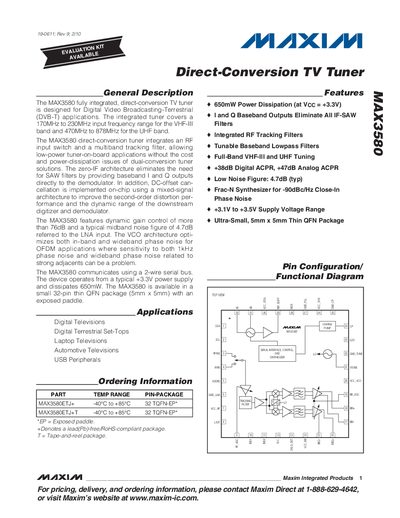
Maxim MAX3580 Direct-Conversion TV Tuner Datasheet
The MAX3580 is a fully integrated direct‑conversion TV tuner designed for DVB‑T applications. It covers a 170 MHz‑230 MHz VHF‑III band and a 470 MHz‑878 MHz UHF band, offering dynamic gain control of more than 760 dB and a typical mid‑band noise figure of 4.7 dB. The device operates from a typical +3.3 V supply and dissipates 650 mW, packaged in a 32‑pin thin QFN (5 mm × 5 mm).
The handbook includes absolute maximum ratings, DC and AC electrical characteristics, performance to standards, typical operating characteristics, and layout recommendations. It also provides ordering information, package details, and revision history for designers and engineers.
Maxim MAX358 specifications
| Input Frequency Range | 170 MHz‑230 MHz (VHF‑III) and 470 MHz‑878 MHz (UHF) |
|---|---|
| Power Dissipation | 650 mW at Vcc = +3.3 V |
| Noise Figure (typical) | 4.7 dB |
| Supply Voltage | +3.1 V to +3.5 V (typical +3.3 V) |
| Package | 32‑pin thin QFN (5 mm × 5 mm) |
| Dynamic Gain Control | more than 760 dB |
All Maxim MAX358 documents by type
Ratings, dimensions and ordering codes, for selection and design work.
Questions answered in these manuals
What is the operating temperature range of the MAX3580?
The device is rated for –40 °C to +85 °C operating temperature.
How does the MAX3580 communicate with a host processor?
It communicates using a 2‑wire serial bus (I²C).
What fault‑protection advantage does the MAX358/359 provide?
It limits fault currents to nanoamp leakage and can tolerate continuous over‑voltage up to +35 V, protecting both the device and connected sensors.
What is the typical power consumption of these multiplexers?
Typical power dissipation is less than 2 mW.