
Key facts
- Brand
- Maxim
- Model
- MAX2055
- Industry
- Industrial
- Documents
- 5
- Languages
- EN
- Last added
- 2012-05-07
Start here
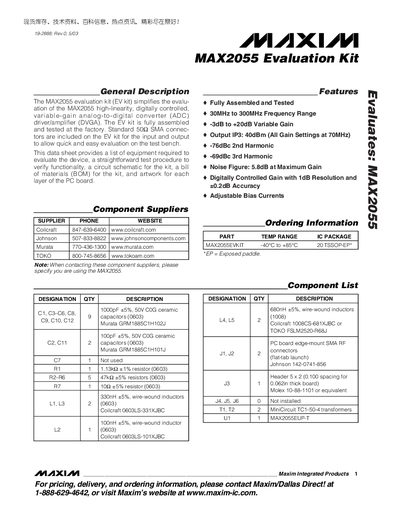
Maxim MAX2055 Evaluation Kit User Manual
The MAX2055 evaluation kit is a fully assembled, factory‑tested board that simplifies evaluation of the MAX2055 high‑linearity, digitally controlled variable‑gain ADC driver. It includes SMA connectors, a 20‑pin TSSOP‑EP package, and a range of components such as inductors, capacitors, and transformers to support operation from 30 MHz to 300 MHz with gain from –3 dB to +20 dB.
The manual offers a quick‑start guide, detailed test procedures, and layout considerations. It explains how to connect power and RF ports, set gain via header pins, measure supply current and power gain, and modify the kit for single‑ended operation. Schematic diagrams and PCB layout figures help users design their own boards based on the evaluation kit.
Maxim MAX2055 specifications
| Frequency Range | 30 MHz – 300 MHz |
|---|---|
| Gain Range | -3 dB to +20 dB |
| Attenuation Range | 23 dB |
| Attenuation Accuracy | ±0.2 dB |
| Output IP3 | 40 dBm |
| Noise Figure (max gain) | 5.8 dB |
| Supply Voltage (VCC) | 4.75 V – 5.25 V |
| Supply Current | 240 mA – 290 mA |
| Operating Temperature | -40 °C to +85 °C |
Source: Maxim MAX2055 Variable‑Gain Differential ADC Driver Datasheet
All Maxim MAX2055 documents by type
Day-to-day operation, settings and troubleshooting. Start here if the product is already set up.
Ratings, dimensions and ordering codes, for selection and design work.
Questions answered in these manuals
What is the attenuation range of the MAX2055?
The MAX2055 provides a digitally controlled attenuation range of 23 dB.
From: Maxim MAX2055 Variable‑Gain Differential ADC Driver Datasheet
What supply voltage does the MAX2055 require?
The device operates with a supply voltage (VCC) between 4.75 V and 5.25 V.
From: Maxim MAX2055 Variable‑Gain Differential ADC Driver Datasheet
What is the frequency range of the MAX2055?
The MAX2055 operates from 30 MHz to 300 MHz.
What supply voltage is required for the MAX2055?
The device requires a supply voltage between 4.75 V and 5.25 V.
What is the attenuation range of the MAX2055?
The MAX2055 provides a 23 dB attenuation range with ±0.2 dB accuracy.
From: Maxim MAX2055 Datasheet
What supply voltage does the MAX2055 require?
It operates from a supply voltage of 4.75 V to 5.25 V.
From: Maxim MAX2055 Datasheet