
Key facts
- Brand
- Analog Devices
- Model
- AD5258
- Industry
- Industrial
- Documents
- 2
- Languages
- EN
- Last added
- 2012-05-09
Start here
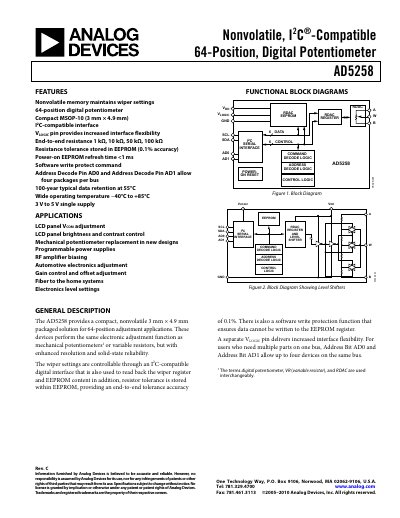
Analog Devices AD5258 Nonvolatile Digital Potentiometer Datasheet
The AD5258 provides a 64‑position digital potentiometer in a small MSOP‑10 package, offering non‑volatile memory to retain wiper settings after power‑off. It features an I2C‑compatible interface, a VLOGIC pin for flexible operation, and address pins AD0/AD1 that allow up to four devices on a single bus.
The device operates from a 2.7 V to 5.5 V supply, supports a wide temperature range (‑40 °C to +85 °C), and includes specifications such as 0.1 % resistance tolerance, 100‑year data retention at 55 °C, and low supply currents for power‑efficient designs.
Analog Devices AD5258 specifications
| Supply Voltage Range | 2.7 V – 5.5 V |
|---|---|
| Operating Temperature Range | ‑40 °C to +85 °C |
| Resistance Tolerance | 0.1 % accuracy |
| Data Retention | 100 years at 55 °C |
| Package | MSOP‑10 (3 mm × 4.9 mm) |
Source: Analog Devices AD5258 Nonvolatile Digital Potentiometer Datasheet
All Analog Devices AD5258 documents by type
Ratings, dimensions and ordering codes, for selection and design work.
Questions answered in these manuals
What is the maximum I2C clock frequency for the AD5258?
The AD5258 supports I2C clock frequencies up to 400 kHz.
From: Analog Devices AD5258 Nonvolatile Digital Potentiometer Datasheet
How many AD5258 devices can share the same I2C bus?
Up to four devices can be placed on the same bus using the AD0 and AD1 address pins.
From: Analog Devices AD5258 Nonvolatile Digital Potentiometer Datasheet
What interface does the AD5258 use?
The AD5258 uses an I²C‑compatible digital interface for reading and writing the wiper register and EEPROM.
How many AD5258 devices can share the same I²C bus?
Up to four AD5258 devices can be placed on a single bus using the ADO and AD1 address‑decode pins.