
Key facts
Start here
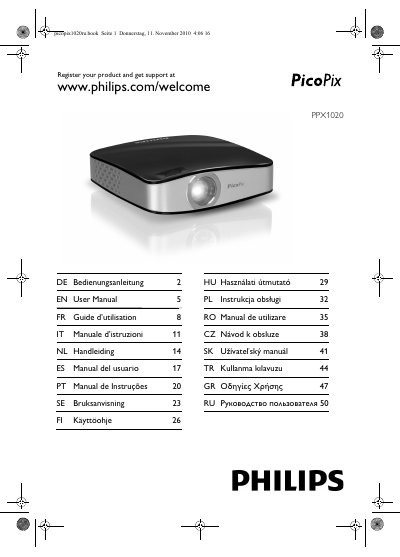
Philips PPX1020 Pocket Projector User Manual
This manual explains how to safely set up and use the Philips PPX1020 pocket projector. It covers safety precautions such as protecting the device from direct sunlight, heat, moisture, dust, and vibration, and provides guidance on handling moisture condensation.
The guide details basic operation, software installation, and connection steps, as well as the technical data, minimum PC requirements, and environmental recommendations for optimal performance.
Philips PPX1020 specifications
| Display technology | 0.37" LCoS |
|---|---|
| Light source | RGB LED |
| Resolution | 800 × 600 pixel |
| Supported resolutions | SVGA / XGA / WXGA |
| Brightness (Bright Mode) | up to 20 lumen |
| Contrast ratio | 400:1 |
| Projected image size | 5.2 – 81 inch |
| Screen distance | 0.2 m – 3 m |
| Horizontal scan rate | 31 – 69 kHz |
| Vertical scan rate | 56 – 85 Hz |
| Power supply | via USB |
| Weight | 0.15 kg |
| Recommended ambient temperature | 5 °C – 40 °C |
| Relative humidity | 20 % – 80 % (non‑condensing) |
All Philips PPX1020 documents by type
Day-to-day operation, settings and troubleshooting. Start here if the product is already set up.
Questions answered in these manuals
What are the minimum PC requirements for the PPX1020?
A processor of Intel Pentium M or AMD Athlon at 2 GHz or higher, Windows XP SP2 / Vista / Windows 7, 1 GB DDR SDRAM, 40 MB free disk space, and a USB 2.0 port.
How should I disconnect the projector before restarting the computer?
Disconnect the device from the computer before restarting to prevent the computer from trying to boot from the projector’s USB storage mode.
How is the PPX1020 powered?
The projector is powered via its mini‑USB 2.0 power cable connected to a USB port.
What is the maximum image size the projector can display?
It can project images up to 203 cm (80 inches) in diagonal size.