
The MAX913 and MAX912 are high-performance, low-power, differential input and complementary TTL output single and dual comparators.
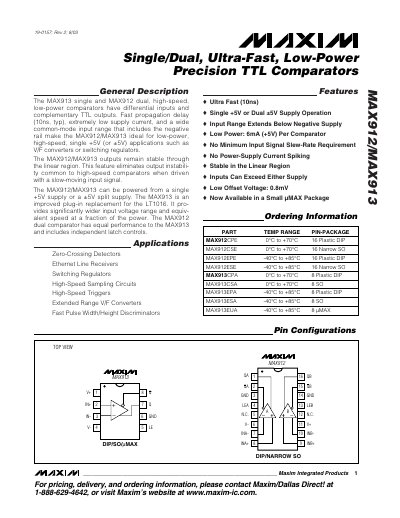
The MAX912 dual and MAX913 single comparators are ultra‑fast, low‑power TTL devices with differential inputs and complementary TTL outputs. They operate from a single +5 V supply or a ±5 V split supply and feature propagation delays as low as 5 ns (MAX912) and 10 ns (MAX913).
The document provides absolute maximum ratings, electrical characteristics, pin descriptions, typical operating curves, and package information for various DIP, SO, and µMAX packages, along with layout and bypass recommendations for high‑speed applications.
| Propagation Delay (typical) | 10 ns (MAX913), 5 ns (MAX912) |
|---|---|
| Supply Current per Comparator | 6 mA (+5 V) per comparator |
The MAX913 has a typical propagation delay of 10 ns.
They can be powered from a single +5 V supply or a ±5 V split supply.
The maximum clock and signal rate is 70 MHz (85 MHz with 20 mV overdrive).