
Key facts
- Brand
- Analog Devices
- Model
- AD8221
- Industry
- Industrial
- Documents
- 4
- Languages
- EN
- Last added
- 2012-05-09
Start here
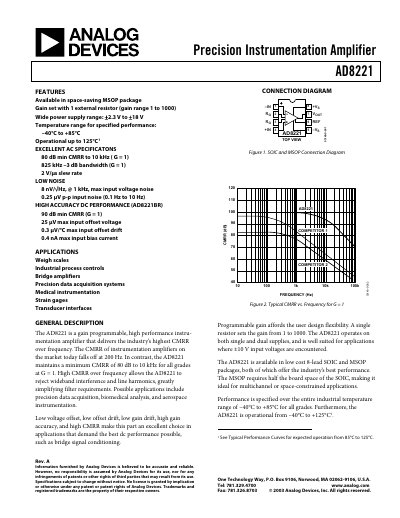
Analog Devices AD8221 Datasheet
The AD8221 precision instrumentation amplifier offers programmable gain from 1 to 1000 using a single external resistor. It provides industry‑leading common‑mode rejection (80 dB minimum to 10 kHz at G=1) and low input noise (8 nV/√Hz at 1 kHz), making it suitable for weigh scales, bridge amplifiers, and medical instrumentation.
The device operates from ±2.3 V to ±18 V supply, supports temperatures from –40 °C to +85 °C (specified performance) and up to +125 °C for operation, and is available in compact MSOP and SOIC packages. Detailed specifications, typical performance curves, and application circuits are provided throughout the document.
Analog Devices AD8221 specifications
| Gain range | 1 to 1000 |
|---|---|
| CMRR (G=1) to 10 kHz | 80 dB min |
| Bandwidth (G=1) | 825 kHz –3 dB |
| Input voltage noise | 8 nV/√Hz @ 1 kHz |
| Supply voltage range | ±2.3 V to ±18 V |
| Operating temperature range (specified performance) | –40 °C to +85 °C |
Source: Analog Devices AD8221 Datasheet
All Analog Devices AD8221 documents by type
Ratings, dimensions and ordering codes, for selection and design work.
Questions answered in these manuals
What is the gain range of the AD8221?
The gain can be set from 1 to 1000 using a single external resistor.
What common‑mode rejection ratio does the AD8221 provide at low gain?
It provides a minimum CMRR of 80 dB up to 10 kHz when the gain is set to 1.
What is the gain range of the AD8221?
The AD8221 gain can be set from 1 to 1000 using a single external resistor.
What power supply voltage range does the AD8221 support?
It operates from ±2.3 V up to ±18 V.
What is the supply voltage range for the AD8221?
The device can be powered from ±2.3 V up to ±18 V.
What is the CMRR at 10 kHz for gain = 1?
The common‑mode rejection ratio is 80 dB.