
Key facts
- Brand
- Analog Devices
- Model
- AD7541A
- Industry
- Industrial
- Documents
- 2
- Languages
- EN
- Last added
- 2012-06-04
Start here
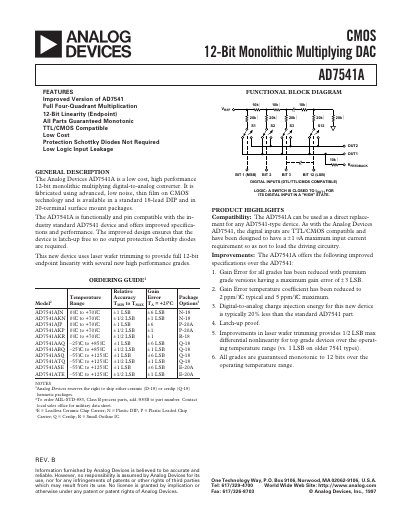
Analog Devices AD7541A 12‑Bit Multiplying DAC Datasheet
The AD7541A is a 12‑bit monolithic multiplying digital‑to‑analog converter fabricated in low‑noise thin‑film CMOS technology. It is offered in 18‑lead DIP, 20‑lead surface‑mount and ceramic leadless packages and is pin‑compatible with the standard AD7541. The device provides full‑scale endpoint linearity, improved gain error and temperature stability, and does not require external Schottky protection diodes.
Typical applications include unipolar binary (2‑quadrant) operation, bipolar (4‑quadrant) multiplication, and single‑supply voltage‑switching configurations. The datasheet includes detailed specifications, absolute maximum ratings, pin configurations, circuit analysis, and ordering information for various temperature‑grade versions.
Analog Devices AD7541A specifications
| Resolution | 12 bits |
|---|---|
| Gain Error | ±6 LSB max (typical grades ±3 LSB) |
| Gain Temperature Coefficient | 2 ppm/°C typical, 5 ppm/°C max |
| Output Leakage Current (OUT1) | ±5 nA max |
| Power Dissipation (any package) | 450 mW at +75 °C |
Source: Analog Devices AD7541A 12‑Bit Multiplying DAC Datasheet
All Analog Devices AD7541A documents by type
Ratings, dimensions and ordering codes, for selection and design work.
Questions answered in these manuals
Does the AD7541A require external Schottky protection diodes?
No, the device is latch‑up‑free and does not need Schottky diodes for output protection.
From: Analog Devices AD7541A 12‑Bit Multiplying DAC Datasheet
What is the gain error temperature coefficient of the AD7541A?
The gain error temperature coefficient is typically 2 ppm/°C and up to 5 ppm/°C maximum.
From: Analog Devices AD7541A 12‑Bit Multiplying DAC Datasheet
Are the digital inputs of the AD7541A TTL/CMOS compatible?
Yes, the digital inputs are TTL/CMOS compatible.
Does the AD7541A require external Schottky protection diodes?
No, the device is latch‑up free and does not require external Schottky diodes.