
Key facts
- Brand
- Linear Technology
- Model
- LT3782A
- Documents
- 2
- Languages
- EN
- Last added
- 2012-06-05
Start here
linear DESIGN FEATURES LTMag-V18N4-08-LT3782A-Narayan_Raja service manual
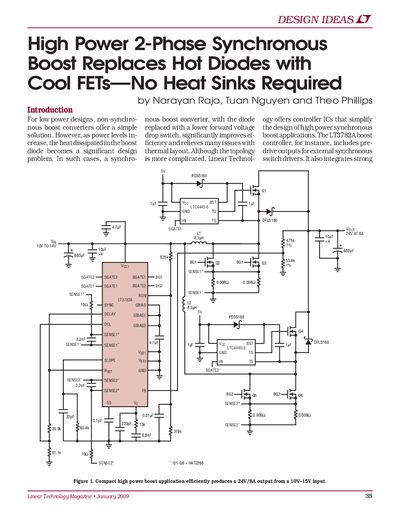
The document presents design ideas for high-power 2-phase synchronous boost converters, specifically highlighting the benefits of replacing traditional boost diodes with low forward voltage drop switches. It features application circuits utilizing the LT3782A boost controller and external drivers to achieve efficient operation without heat sinks.
The text includes detailed analysis of thermal performance comparisons between synchronous FET solutions and non-synchronous diode topologies, demonstrating significant reductions in power dissipation and board temperature at high current levels. It also covers multiphase operation advantages for reducing application size and EMI.
All Linear Technology LT3782A documents by type
How to use the product for one specific task, with worked examples.
Questions answered in these manuals
What are the advantages of a synchronous boost converter over a non-synchronous one?
Synchronous converters use lower forward voltage drop switches instead of diodes, significantly improving efficiency and relieving thermal layout issues.
From: linear DESIGN FEATURES LTMag-V18N4-08-LT3782A-Narayan_Raja service manual
What output voltage and current does the circuit in Figure 1 produce?
The circuit efficiently produces a 24V/8A output from a 10V-15V input.
From: linear DESIGN FEATURES LTMag-V18N4-08-LT3782A-Narayan_Raja service manual
What output voltage and current ratings does this boost converter provide?
The circuit generates a 24V output at 8.5A continuous current and 10.5A pulsed current.
What is the input voltage range for this converter?
The device operates with an input voltage ranging from 8.5V to 18V.