
Key facts
- Brand
- Linear Technology
- Model
- LTC4355
- Category
- Other Electronics
- Documents
- 2
- Languages
- EN
- Last added
- 2012-06-05
Start here
linear DESIGN FEATURES LTMag-V18N02-14-LTC4355_57-MeilissaLum service manual
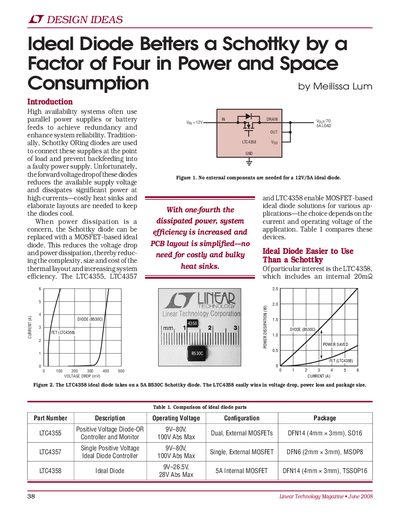
The article discusses how traditional Schottky ORing diodes reduce available voltage and dissipate significant power in high-current systems. It introduces MOSFET-based ideal diode solutions as a more efficient alternative that reduces heat dissipation and simplifies PCB layout.
Specifically, the document highlights the LTC4358 controller, which includes an internal MOSFET pass element. This device offers lower voltage drop and power loss compared to standard Schottky diodes like the B530C, allowing for smaller packages and eliminating the need for bulky heat sinks in many applications.
All Linear Technology LTC4355 documents by type
How to use the product for one specific task, with worked examples.
Questions answered in these manuals
How much power does the LTC4358 dissipate at a 5A load compared to a Schottky diode?
The LTC4358 dissipates 0.5W, whereas a comparable Schottky diode dissipates 2W.
From: linear DESIGN FEATURES LTMag-V18N02-14-LTC4355_57-MeilissaLum service manual
How do ideal diodes protect against wiring errors?
They provide protection similar to discrete diode solutions, making wiring errors transparent to the load or preventing damage through reverse input protection networks.
From: Linear Technology LTC4355/LTC4354 Ideal Diode Design Note 444
What happens if RTNA and NEGA are swapped?
The associated ideal diodes become reverse biased, making the wiring error transparent to the load while the other battery provides power.
From: Linear Technology LTC4355/LTC4354 Ideal Diode Design Note 444