
Key facts
- Brand
- Linear Technology
- Model
- LTC3856
- Category
- Other Electronics
- Documents
- 2
- Languages
- EN
- Last added
- 2012-06-05
Start here
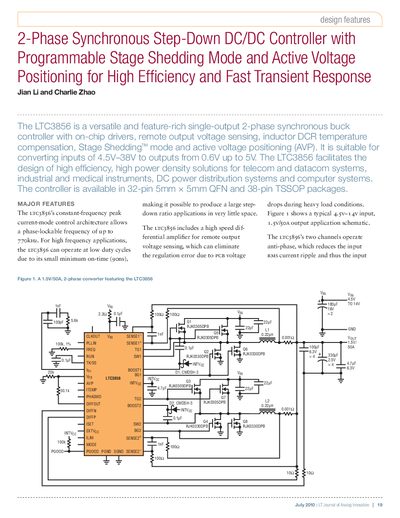
linear DESIGN FEATURES LTJournal-V20N2-02-df-LTC3856-Jian-Li service manual
The document describes the design features of the LTC3856, a versatile single-output 2-phase synchronous buck controller. It includes on-chip drivers, remote output voltage sensing, inductor DCR temperature compensation, and Stage Shedding mode for high efficiency.
Key features include active voltage positioning (AVP) to improve transient response, programmable stage shedding to reduce switching losses at light loads, and the ability to operate up to 12-phase by combining multiple units. The controller supports input voltages from 4.5V to 38V.
All Linear Technology LTC3856 documents by type
Ratings, dimensions and ordering codes, for selection and design work.
Questions answered in these manuals
What is the maximum input voltage range for the LTC3856?
The controller can convert inputs ranging from 4.5V to 38V.
From: linear DESIGN FEATURES LTJournal-V20N2-02-df-LTC3856-Jian-Li service manual
What is the maximum output voltage supported by this controller?
The device can produce outputs up to 5V.
From: linear DESIGN FEATURES LTJournal-V20N2-02-df-LTC3856-Jian-Li service manual
What is the input voltage range for the LTC3856?
The device can convert a wide input voltage range from 4.5V to 38V.
How much does Stage Shedding mode improve efficiency at 5% load?
At 5% load, the efficiency is improved by 13%.