
Key facts
- Brand
- Linear Technology
- Model
- LT6105
- Category
- Other Electronics
- Documents
- 2
- Languages
- EN
- Last added
- 2012-06-05
Start here
linear DESIGN FEATURES LTMag-V18N01-07-LT6105_6_7-Jett service manual
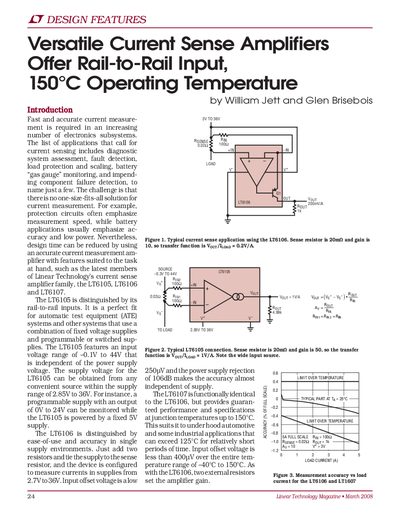
This document introduces the LT6105, LT6106, and LT6107 family of versatile current sense amplifiers designed for accurate measurement in various electronics subsystems. The LT6105 is distinguished by its rail-to-rail inputs and wide input voltage range (-0.3V to 44V), making it suitable for monitoring programmable supplies and fuses. The LT6106 offers ease of use with low offset voltage, while the functionally identical LT6107 provides guaranteed performance at junction temperatures up to 150°C.
Read onlineLinear Technology LT6105 specifications
| Input Voltage Range (LT6105) | -0.3V to 44V |
|---|---|
| Supply Voltage Range (All Models) | 2.7V to 36V |
| Input Offset Voltage (LT6106) | 250pV |
| Power Supply Rejection Ratio (PSRR) LT6106/7 | 106dB |
| Maximum Junction Temperature (LT6107) | 150°C |
Source: linear DESIGN FEATURES LTMag-V18N01-07-LT6105_6_7-Jett service manual
All Linear Technology LT6105 documents by type
How to use the product for one specific task, with worked examples.
Questions answered in these manuals
What distinguishes the LT6107 from the LT6106?
The LT6107 is functionally identical to the LT6106 but provides guaranteed performance and specifications at junction temperatures up to 150°C.
From: linear DESIGN FEATURES LTMag-V18N01-07-LT6105_6_7-Jett service manual
Can the LT6105 monitor across a fuse or MOSFET?
Yes, the LT6105 can be used to sense across fuses or MOSFETs without concern for an open circuit condition due to its high voltage PNP's and unique input topology.
From: linear DESIGN FEATURES LTMag-V18N01-07-LT6105_6_7-Jett service manual
What is the input common mode voltage range for the LT6105?
The inputs can monitor voltages from -0.3V to 44V regardless of the supply voltage.
What is the gain error specification for the LT6105?
The output accuracy is specified as 25mV per mA of current.