
Key facts
- Brand
- Linear Technology
- Model
- LTC3219
- Category
- LED Driver Controller
- Documents
- 2
- Languages
- EN
- Last added
- 2012-06-05
Start here
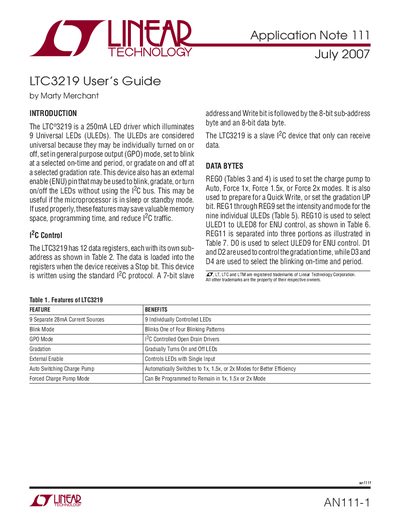
Linear Technology LTC3219 User's Guide Application Note 111
The LTC3219 is a 250mA LED driver designed to illuminate nine Universal LEDs (ULEDs). These LEDs can be individually turned on or off, set in general purpose output mode, configured to blink at selected rates, or gradually turn on and off. The device features an external enable pin for control without using the I2C bus.
The guide details how to configure the device using 12 data registers via standard I2C protocol. It provides instructions for setting LED intensity, enabling blinking modes with four different patterns, and controlling gradual transitions (gradation) of LEDs from off to on or vice versa.
Linear Technology LTC3219 specifications
| Total LED Output Current | Up to 250 mA |
|---|---|
| Number of LED Current Sources | 9 |
| Package | 20‑Lead (3 mm × 3 mm) Plastic QFN |
| Operating Voltage Range | 2.9 V to 5.5 V |
| Maximum Efficiency | Up to 91 % |
| Interface | 2‑Wire I²C™ |
| Clock Frequency | 0.65 – 1.05 MHz |
| Shutdown Current | 3.2 pA |
All Linear Technology LTC3219 documents by type
Day-to-day operation, settings and troubleshooting. Start here if the product is already set up.
Ratings, dimensions and ordering codes, for selection and design work.
Questions answered in these manuals
How many data registers does the LTC3219 have?
The device has 12 data registers, each with its own sub-address.
From: Linear Technology LTC3219 User's Guide Application Note 111
Can the LEDs be controlled without using the I2C bus?
Yes, an external enable (ENU) pin can be used to control the LEDs.
From: Linear Technology LTC3219 User's Guide Application Note 111
What is the maximum total LED output current of the LTC3219?
The device can drive up to 250 mA total LED output current.
How many independent LED current sources does the LTC3219 provide?
It provides nine universal LED current sources, each controllable via I²C.