
Key facts
- Brand
- Linear Technology
- Model
- LTC1966
- Category
- Other Electronics
- Documents
- 4
- Languages
- EN
- Last added
- 2026-11-18
Start here
Linear Technology LTC1966 True RMS-to-DC Converter Design Note 339
This design note by Philip Karantzalis and Jim Mahoney describes the LTC1966, a true RMS-to-DC converter that uses a delta-sigma computational technique instead of the conventional log-antilog approach. The LTC1966 has an input signal range from 5mV RMS to 1.5V RMS, a 50dB dynamic range on a single 5V supply rail, a 3dB bandwidth of 800kHz, and handles signal crest factors up to four.
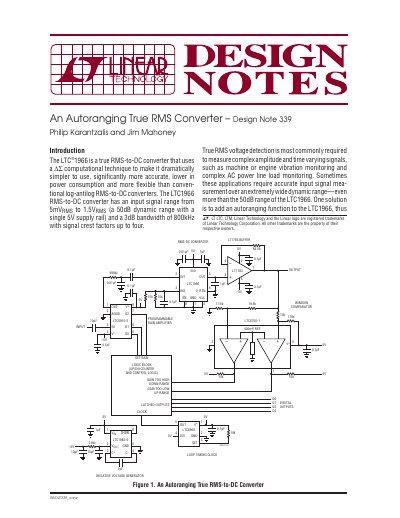
The note shows how to extend that range with an autoranging loop: an LTC6910-2 programmable gain amplifier in front of the LTC1966, an LT1783 buffer, an LT6700-1 window comparator with a 400mV reference, an up/down counter, and an LTC6900 oscillator that sets the loop response time. The circuit runs from a single 5V supply with an LTC1983-5 charge pump inverter for the negative rail, reaches an 80dB input dynamic range with a 12Hz to 32kHz conversion bandwidth, and reports the gain setting through digital outputs.
Linear Technology LTC1966 specifications
| Input signal range | 5mV RMS to 1.5V RMS |
|---|---|
| Dynamic range (single 5V supply) | 50dB |
| 3dB bandwidth | 800kHz |
| Signal crest factor | up to four |
| Autoranging input dynamic range | 80dB |
| Autoranging conversion bandwidth | 12Hz to 32kHz |
| Window comparator thresholds | 9.5mV and 1.5V |
| PGA gain settings | 1, 2, 4, 8, 16, 32 or 64 |
| Conversion error | less than 1% from 50mV RMS to 1.5V RMS input, rising to 5% at 9.5mV RMS |
| 1% error bandwidth | 6kHz |
Source: Linear Technology LTC1966 True RMS-to-DC Converter Design Note 339
All Linear Technology LTC1966 documents by type
How to use the product for one specific task, with worked examples.
Ratings, dimensions and ordering codes, for selection and design work.
Questions answered in these manuals
What is the input signal range of the LTC1966?
The LTC1966 accepts 5mV RMS to 1.5V RMS, a 50dB dynamic range on a single 5V supply rail.
From: Linear Technology LTC1966 True RMS-to-DC Converter Design Note 339
What is the autoranging conversion bandwidth?
The autoranging true RMS-to-DC conversion bandwidth is 12Hz to 32kHz.
From: Linear Technology LTC1966 True RMS-to-DC Converter Design Note 339
What is the input signal dynamic range of the autoranging converter shown in Figure 1?
The circuit has an input signal dynamic range of 80dB.
From: Linear Technology LTC1966 Autoranging True RMS Converter Design Note 339
What are the threshold levels set for the window comparator?
The thresholds are set to 9.5mV and 1.5V.
From: Linear Technology LTC1966 Autoranging True RMS Converter Design Note 339
What is the accuracy of the RMS converters at low frequencies?
Low frequency accuracy, including linearity and gain error, is inside 0.5%.
From: LINEAR AN106-1 handbook
What is the accuracy of the LTC1966/LTC1967/LTC1968 device family at bandwidths up to 500kHz?
The low frequency accuracy, including linearity and gain error, is inside 0.5% with a 1% error.
From: LINEAR AN106-1 handbook