
Key facts
- Brand
- Linear Technology
- Model
- AN-2
- Category
- Other Electronics
- Documents
- 7
- Languages
- EN
- Last added
- 2012-06-05
Start here
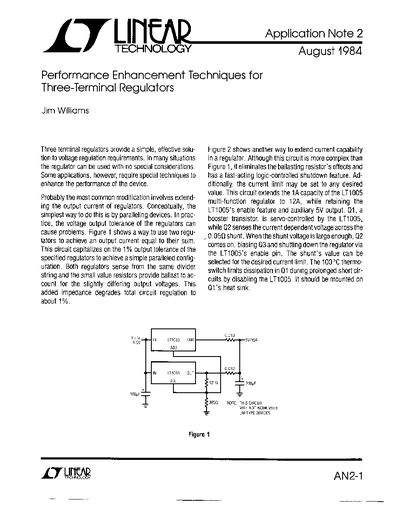
LINEAR Performance Enhancement Techniques for 3-Terminal Regulators Application Note
The document details methods for increasing the output current capability of linear regulators. It presents a simple paralleling configuration using ballast resistors and a more complex logic-controlled shutdown circuit that extends the capacity of the LT1005 to 12A while maintaining stability features.
Additionally, the note covers power dissipation control strategies. It describes switched-mode loops that servo-control voltage across the regulator to minimize heat generation without sacrificing linear performance or transient response. The text also includes a high-voltage regulator design capable of delivering 100V at 100mA with short-circuit protection.
Linear Technology AN-2 specifications
| Bandwidth (500 Input) | DC to 100MHz |
|---|---|
| Full-Scale Settling Time (500 Input) | 500ms |
| Temperature Effect on Accuracy | 100ppm/°C |
Source: Linear Technology LT1088 RMS-DC Converter Application Note AN22-1
All Linear Technology AN-2 documents by type
How to use the product for one specific task, with worked examples.
- LINEAR Performance Enhancement Techniques for 3-Terminal Regulators Application Note 8 p
- LINEAR AN20-1 Data Sheet 12 p
- Linear Technology LT1088 RMS-DC Converter Application Note AN22-1 16 p
- Linear Technology AN25-1 Switching Regulators Application Note 24 p
- Linear Technology AN28 Thermocouple Measurement Application Note 20 p
- Linear Technology AN27A Application Note: Designing Bandpass Filters by Cascading 2nd Order Sections 16 p
Questions answered in these manuals
How can the output current of a regulator be extended using paralleled devices?
Two regulators are used with small value resistors to provide ballast, which accounts for differing output voltages and achieves an output current equal to their sum.
From: LINEAR Performance Enhancement Techniques for 3-Terminal Regulators Application Note
What component limits dissipation in Q1 during prolonged short circuits?
The 100°C thermo-switch disables the LT1005 to limit dissipation and should be mounted on Q1's heat sink.
From: LINEAR Performance Enhancement Techniques for 3-Terminal Regulators Application Note
What is the maximum guaranteed offset voltage over temperature for the buffered output?
The maximum guaranteed offset voltage over temperature is 20mV.
From: LINEAR AN20-1 Data Sheet
What clock frequency should be used for a maximally flat amplitude response?
The clock should be 100 times the desired cutoff frequency.
From: LINEAR AN20-1 Data Sheet
What is the primary advantage of the LT1088 over previous monolithic circuits?
It uses a thermal conversion method that provides substantially improved bandwidth and crest factor capability compared to logarithmic-based converters.
From: Linear Technology LT1088 RMS-DC Converter Application Note AN22-1
What die attach method does the LT1088 use to maximize thermal resistance?
The IC uses an air impregnated polymer die attach produced by the OTT (Oracular Thermal Transfer) process.
From: Linear Technology LT1088 RMS-DC Converter Application Note AN22-1