
Key facts
- Brand
- Maxim
- Model
- MAX1473
- Industry
- Industrial
- Documents
- 2
- Languages
- EN
- Last added
- 2012-05-07
Start here
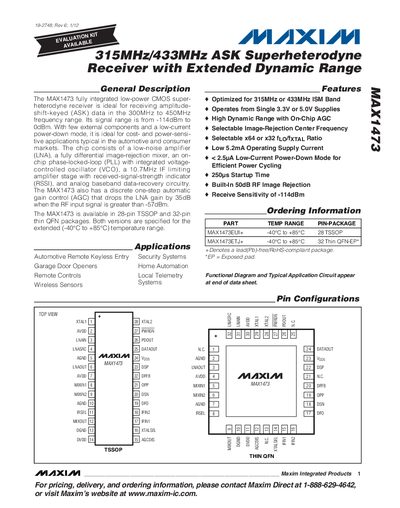
Maxim MAX1473 Superheterodyne Receiver Datasheet
The MAX1473 is a fully integrated low‑power CMOS super‑heterodyne receiver optimized for 315 MHz or 433 MHz ISM bands. It offers high dynamic range, on‑chip AGC, and selectable image‑rejection frequencies, making it suitable for security systems, home automation, automotive remote keyless entry, garage door openers, and other remote‑control applications.
The datasheet provides absolute maximum ratings, DC and AC electrical characteristics, typical operating curves, pin descriptions, functional diagrams, and package information for the 28‑pin TSSOP and 32‑pin thin QFN versions. It also includes ordering information and revision history.
Maxim MAX1473 specifications
| Frequency range | 300 MHz to 450 MHz |
|---|---|
| Supply voltage (typical) | 3.3 V |
| Package options | 28‑pin TSSOP, 32‑pin thin QFN |
All Maxim MAX1473 documents by type
Ratings, dimensions and ordering codes, for selection and design work.
Questions answered in these manuals
What supply voltage does the MAX1473 require?
The device operates from a nominal 3.3 V supply (typical range 3.0 V to 3.6 V).
What supply voltage does the MAX1473 require?
The device operates from a single 3.3 V or 5.0 V supply, with a nominal supply voltage of 3.3 V.
What is the maximum input signal level before AGC reduces gain?
When the RF input signal exceeds –57 dBm, the one‑step AGC reduces the LNA gain by 35 dB.